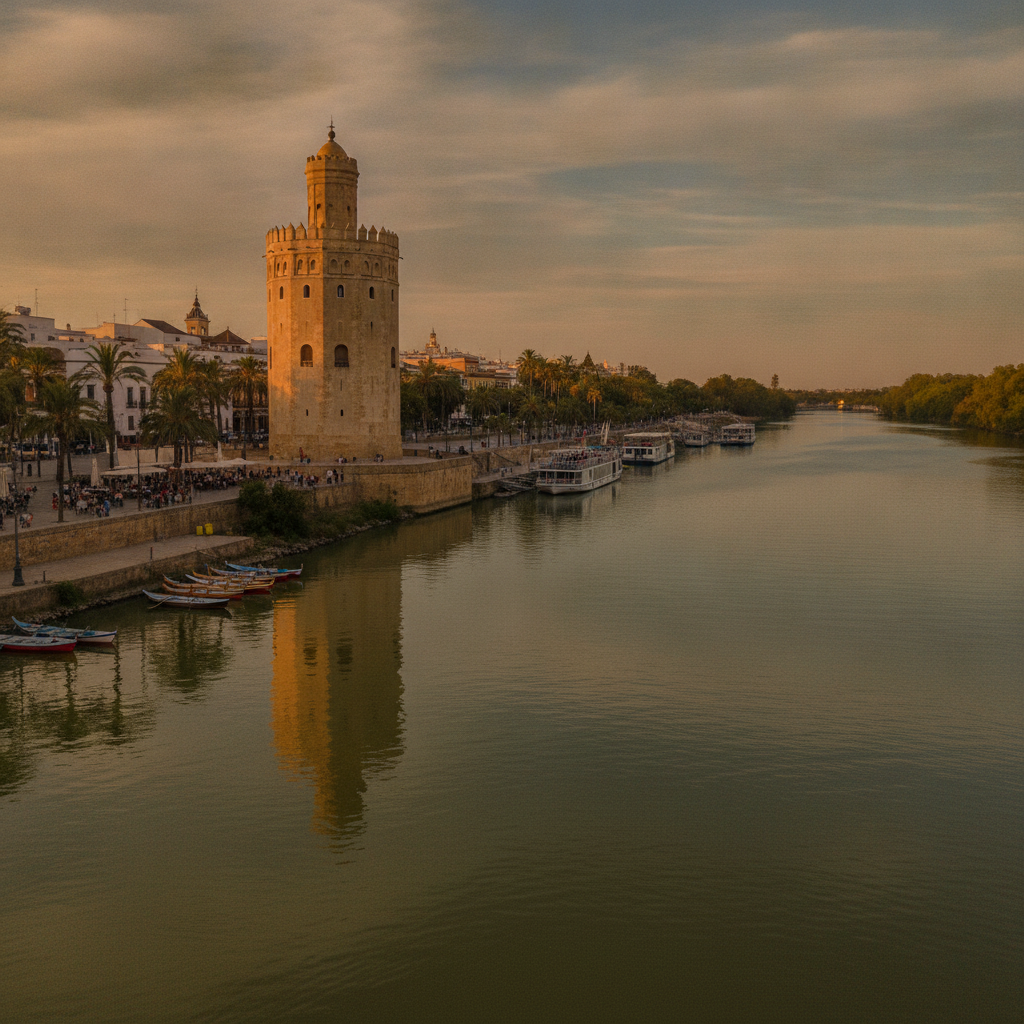
Fiume Guadalquivir, Torre dell'Oro e il Lungofiume di Siviglia
The Torre del Oro (the 'Golden Tower' — the 13th-century Almohad watchtower on the bank of the Guadalquivir River, built c.1220 as part of the defensive wall of Almohad Seville) and the Paseo de Colón (the riverside promenade along the Guadalquivir — the promenade from which Columbus set sail for the Americas in 1492) are the defining landmarks of Seville's historic waterfront.
- 1
Torre del Oro — The Alchemist's Tower on the River
The Torre del Oro (Paseo de Cristóbal Colón, 1220, Almohad construction, the octagonal river guard tower connected to the Alcázar by a now-demolished wall) was built to control river access to the city by a chain stretched across the Guadalquivir to a smaller opposite tower — the tower's name (Tower of Gold) is attributed either to the golden ceramic tiles that once covered it (now in the Naval Museum, ground floor, free) or to the gold stored here after Columbus's voyages; the tower's interior (€3, Tuesday–Friday 9:30am–6:45pm) is a Naval Museum.
- 2
Guadalquivir River — The Only Navigable River in Spain
The Guadalquivir (from the Arabic Wādi al-Kabīr, 'the great valley') is the only river in Spain that remains navigable — the river passes through Córdoba and Seville before reaching the Atlantic at Sanlúcar de Barrameda; Seville (85km from the Atlantic) was the only officially authorized port for trade with the Americas (1503–1717, the Casa de Contratación monopoly) precisely because the river allowed ocean-going ships to reach the city; the Triana Bridge (Isabel II Bridge, the oldest bridge in Seville, 1852) and the EXPO '92 site (La Cartuja island in the river) are on the waterway.
- 3
Real Maestranza de Caballería de Sevilla — The Oldest Bullring
The Plaza de Toros de la Real Maestranza de Caballería de Sevilla (Paseo de Cristóbal Colón, 1761–1881, the oldest and most aesthetically important bullring in the world) is where bullfighting as a formal spectacle was codified — the ring (12,500 capacity, the ocher-painted exterior, the white Baroque gateway) is the building that appears in the poster art of bullfighting globally; the Maestranza season (March–October, every Sunday, the April Fair special corridas) draws the most important matadors in Spain; the guided tour (€10, daily 9:30am–9pm except fight days) includes the museum (original costumes and Goya's portraits of famous matadors).
- 4
Calle Betis — Triana's Riverside Bar Street
Calle Betis (the street running parallel to the Guadalquivir on the Triana side, opposite the Torre del Oro, the most concentrated bar and tapas street in Seville outside the Barrio Santa Cruz) is where Seville's locals go for evenings on the river — the terraces (Bar Bistec, the oldest; La Albariza, the finest tapas; and Casa Cuesta, for the best montaditos) overlook the Torre del Oro and the Giralda from across the water; the riverside walk from Calle Betis south to the San Telmo Palace is the finest evening promenade in Seville.
- 5
Flamenco in Triana — The Art Form's Origin Neighbourhood
Triana (the neighbourhood across the Guadalquivir from the historic centre, the traditional neighbourhood of Seville's gitano/Romani community and the birthplace of the flamenco cantaores who created the art's deepest forms) has the most authentic flamenco atmosphere in Seville — the Museo del Arte Flamenco de Triana (Plaza del Altozano, Triana, €6) and the peñas flamencas (private flamenco clubs, the most closed to tourists) are in the neighbourhood; the annual Potaje Gitano de Utrera (the oldest flamenco festival, 40km from Seville, June) is where serious flamenco artists perform.
- 6
Expo '92 Site — Cartuja Island's Post-World's-Fair Life
La Isla de la Cartuja (the island in the Guadalquivir used for Expo '92, the World's Fair celebrating the 500th anniversary of Columbus's voyage, 42.5 million visitors over 6 months) has been partially converted to the Cartuja Science and Technology Park (400+ companies, 10,000 workers) and the Isla Mágica amusement park (€27 entry, the rides themed around the Age of Discovery) — the original Expo '92 pavilions (many now used as offices or derelict) are the most interesting post-fair legacy of any World's Fair after Montreal's Expo 67; the Pabellon de la Navegación (€6) explores Seville's maritime history.