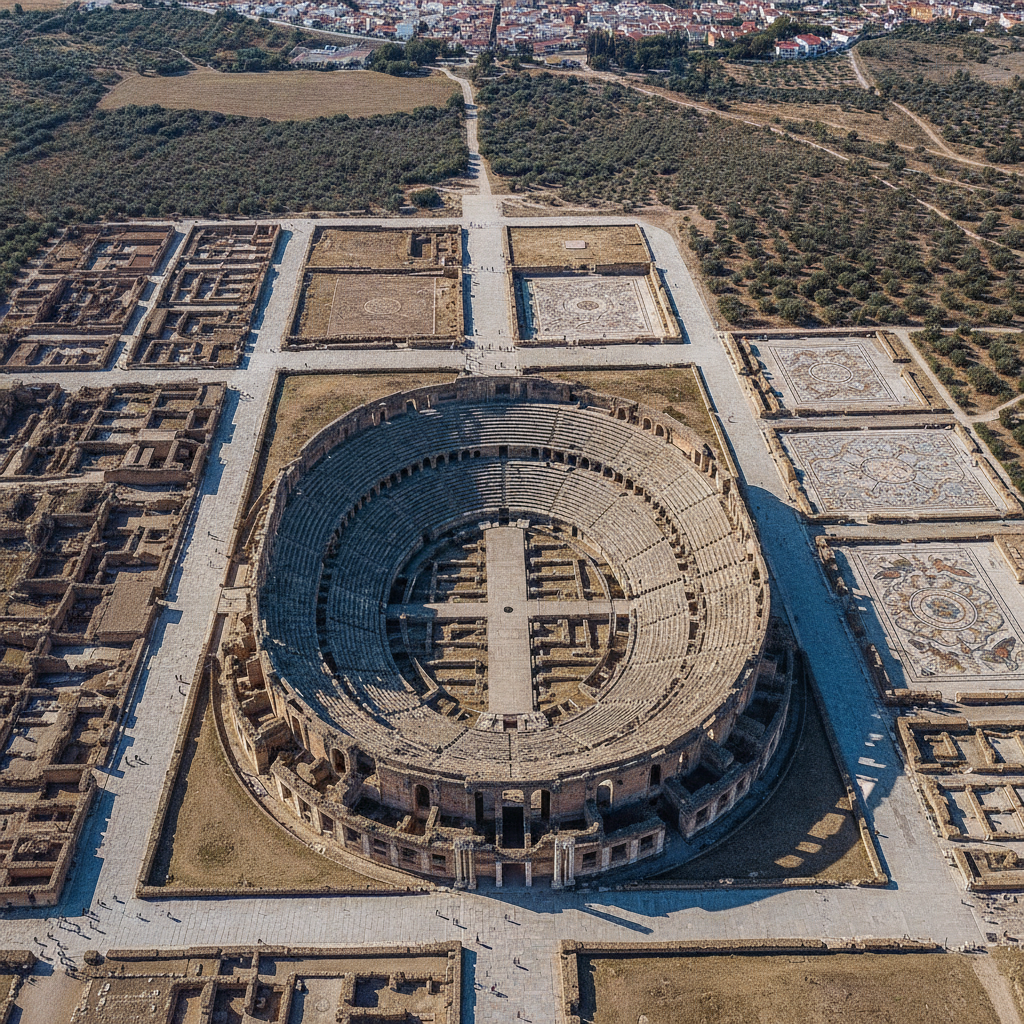
Rovine Romane di Italica e le Origini di Siviglia
Itálica (the Roman city immediately north of Seville, in the modern municipality of Santiponce — founded in 206 BCE by the Roman general Scipio Africanus (the general who defeated Hannibal at the Battle of Zama in 202 BCE) as the first Roman city in Hispania, the birthplace of the emperors Trajan (53-117 CE) and Hadrian (76-138 CE)) is the most important Roman archaeological site in Andalusia and one of the most significant Roman sites in the Iberian Peninsula.
- 1
Italica — The Roman City That Produced Two Emperors
Itálica (Santiponce, 9km north of Seville, bus from Plaza de Armas, 20 minutes, €1.50 adults EU residents free, Tuesday–Sunday 9am–3pm Tuesday 3pm–sunset) was founded in 206 BCE by the Roman general Scipio Africanus for his veterans — the city is the birthplace of Emperors Trajan (53 CE, the first non-Italian Roman emperor, who extended the empire to its maximum territorial extent) and Hadrian (76 CE, who ordered the construction of the Pantheon and Hadrian's Wall) — the 2nd-century expansion under Hadrian included a forum, amphitheatre (25,000 seats, 4th largest in the Roman world), baths, and the Casa de los Pájaros (the finest intact Roman mosaic floor in Spain).
- 2
The Hadrianic Amphitheatre — Game of Thrones Dragonpit
The amphitheatre of Itálica (the 3rd-largest in the Roman Empire outside Italy, 25,000 capacity, built under Hadrian 117–138 CE) was used in Game of Thrones as the Dragonpit (Season 7, the scene where Jon Snow, Daenerys, and Cersei meet) — the arena floor (partially collapsed into the original drainage tunnel system below) and the vaulted underground animal and gladiator preparation chambers are the most atmospheric elements; the surrounding suburbium (the Hadrianic expansion of the original Republican town) has been excavated to reveal a comprehensive Roman street grid.
- 3
Roman Mosaics — The Casa de los Pájaros and Neptune's Collection
The Casa de los Pájaros (the House of Birds, Itálica) contains the finest intact Roman mosaic floor in Spain — the 33-panel mosaic (35m × 14m total area) depicts 37 identified bird species in a geometric border framework; the adjacent Casa de los Planetarios (the House of the Planetary Gods, also Itálica) has a mosaic depicting the seven planetary deities of the week (the origin of our day-name system: Saturn/Satur-day, Sol/Sun-day, Luna/Mon-day, Mars/Mardi/Tuesday, Mercury/Mercredi/Wednesday, Jupiter/Jeudi/Thursday, Venus/Vendredi/Friday) in their chariot medallions.
- 4
Carmona — The Roman Necropolis and Moorish Town
Carmona (37km east of Seville, bus from Prado de San Sebastián, 45 minutes) is the finest day trip from Seville — the Roman Necropolis (1st–4th century CE, 900+ tombs, the most complete Roman burial complex in Spain outside Tarragona, free on European Heritage Days) and the medieval Alcázar de la Puerta de Sevilla (the gate-fortress, free, the finest Almohad military architecture in the province) make Carmona the most rewarding small town within an hour of Seville; the Parador de Carmona (4-star hotel in the medieval castle, panoramic terrace restaurant) is the finest provincial hotel near Seville.
- 5
Córdoba — The Caliphate's Capital, 2.5 Hours by Slow Train
Córdoba (2.5 hours from Seville by slow train through olive groves, or 45 minutes by AVE) was the capital of the Caliphate of Córdoba (929–1031 CE) and the largest city in Europe (500,000 people at its peak) — the Mezquita (the mosque-cathedral, UNESCO, 786 CE expanded to 23,400m², the largest medieval mosque exterior in the world, €13 adults) with its forest of 856 red-and-white striped arches is the defining monument of Islamic Spain; the Medina Azahara (the caliphal palace outside the city, UNESCO, 936 CE, 1km² of partially excavated ruins) is the second Córdoba essential.
- 6
Doñana National Park — Europe's Most Important Wetland
Doñana National Park (Almonte municipality, 543km², accessible from Seville, 1.5 hours by car or guided tour, UNESCO) is the most important bird migration stop in Europe — the marismas (the seasonal wetlands, flooded in winter and dried in summer) support 400,000+ migratory waterbirds (greater flamingos, greylag geese, black-winged stilts, marbled teal, white-headed duck); the European population of Imperial Eagle (the world's most endangered eagle, 60 pairs in Spain) nests in Doñana; guided jeep tours (€35, 4 hours, departing from El Acebuche visitor centre) are the required access method.