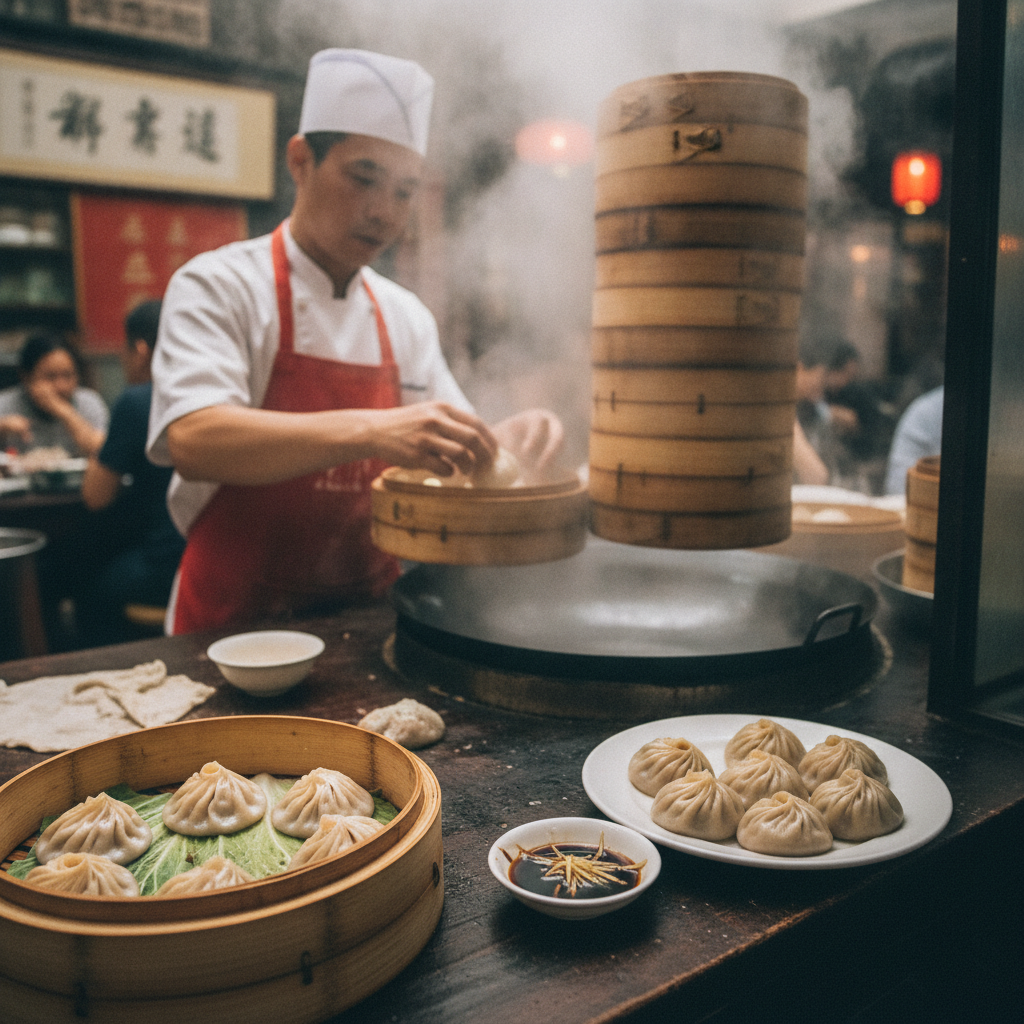
Gastronomia di Shanghai — Granchio Peloso, Maiale Brasato Rosso e l'Arte dello Xiaolongbao
Shanghai cuisine (沪菜 — characterized by its sweetness, its celebration of seasonal produce (the hairy crab, the spring bamboo shoot), and its masterful use of slow braising): Shanghainese food represents one of the great regional cuisines of China, deeply connected to the flat, water-rich Yangtze delta landscape and the city's history as a port of trade.
- 1
Xiaolongbao — Din Tai Fung's Benchmark Soup Dumpling
Xiaolongbao (小笼包, 'small basket bun', steamed soup dumplings with a pork and aspic filling — the aspic melts into hot broth during steaming, filling the thin skin with soup) is the signature Shanghai dim sum — the original xiaolongbao restaurant (Nanxiang Mantou Dian, Nanjing Donlu 1460, founded 1900 in Nanxiang Town, Jiading, now in the City God Temple area as well) and Din Tai Fung (the Taiwanese chain, ironically, that codified the standard: 18 folds, 5g skin, 16g filling with guaranteed internal volume of soup) define the benchmark; the correct eating technique: bite a tiny hole, slurp the soup, then eat with ginger and black vinegar.
- 2
Hairy Crab Season — October to December's Luxury Ingredient
Dazha Xie (大闸蟹, Chinese mitten crab, hairy crab, the Shanghai-area delicacy from Lake Taihu and Yangcheng Lake, October–December, the female crabs for the first 3 weeks — their roe fills the body cavity with deep orange paste — then the male crabs for the following 6 weeks — their white fat is the superior component) is China's most seasonal luxury ingredient — the authentic Yangcheng Lake crab (certified by the Yangcheng Lake Hairy Crab Association, ¥150–500 per crab) has a laser-etched serial number for authenticity; the best restaurants for hairy crab in Shanghai are Jinxiu Lou and Wang Baohe (established 1744 as a hairy crab restaurant).
- 3
Shanghainese vs Cantonese Dim Sum — The Northern Taste
Shanghai cuisine (本帮菜, benbang cai, 'native place cuisine') is distinguished from Cantonese dim sum by its use of red-braised (红烧) techniques, sweeter seasoning, and emphasis on freshwater fish and shellfish — the essential Shanghainese dishes: hongshao rou (red-braised pork belly, the benchmark of every Shanghai restaurant), qingzheng luyu (steamed Yangtze River bass with ginger and spring onion), and biangbiang (oil-poached spring onion), served in the shikumen lane-house restaurants of Huangpu and Jing'an; the Shanghainese restaurant Quanjude (local style, not the Beijing duck chain) and Jesse Restaurant (Tianping Road) are the benchmarks.
- 4
Nanjing Road Pedestrian Street — 5km of Commercial Shanghai
Nanjing Road (南京路, from the Bund to Jing'an Temple, divided into Nanjing East Road pedestrian zone and Nanjing West Road luxury commercial street, 5.5km total) is China's most commercially valuable street by foot traffic — the pedestrian zone (from Nanjing East Road Metro Station to He'nan Road, 1.2km) handles 1 million+ pedestrians per day on weekends; the historic department stores (Shanghai No.1 Department Store, 1936, the former Sun Company, the oldest in China; Laoximen, the traditional goods bazaar) and the tourist shops selling Shanghainese specialties (White Rabbit candy, Dragon Well tea, hairy crab paste) occupy the ground floors.
- 5
City God Temple and Yu Garden — The Ming Dynasty Oasis
The City God Temple Bazaar (豫园商城, Yuyuan Shangcheng, Huangpu, surrounding the Yu Garden/Yuyuan, the most-visited tourist site in Shanghai, 5 million+ per year) centers on the Yu Garden (豫园, 1577 Ming Dynasty, Pan En garden, 2 hectares of rockery, lotus ponds, and painted pavilions, ¥40 adults) and the adjacent Old Street (Fuyou Road, recreated Qing-dynasty commercial street) where: nanxiang xiaolongbao, scallion oil noodles (葱油面, cong you mian), and tanghulu (sugar-coated hawthorn on a stick) are sold from traditional-style storefronts.
- 6
Authentic Shanghainese Food Tour — The Longtang Lane Experience
The longtang (弄堂, lane-house alleys) of Jing'an and Xuhui districts are where authentic Shanghainese home cooking is most accessible in restaurant form — Chun (Hunan Road 124, Jing'an, 4 tables, no English menu, the qingzheng fish and lion's head meatball are the required orders), Meilong Zhen (Nanjing West Road, the restaurant that codified the Shanghainese banquet menu in the 1930s, still using the same kitchen), and the Ye Shanghai (South Maoming Road, Art Deco interior, the best comprehensive Shanghainese menu for first-time visitors) represent the spectrum from neighborhood to heritage dining.