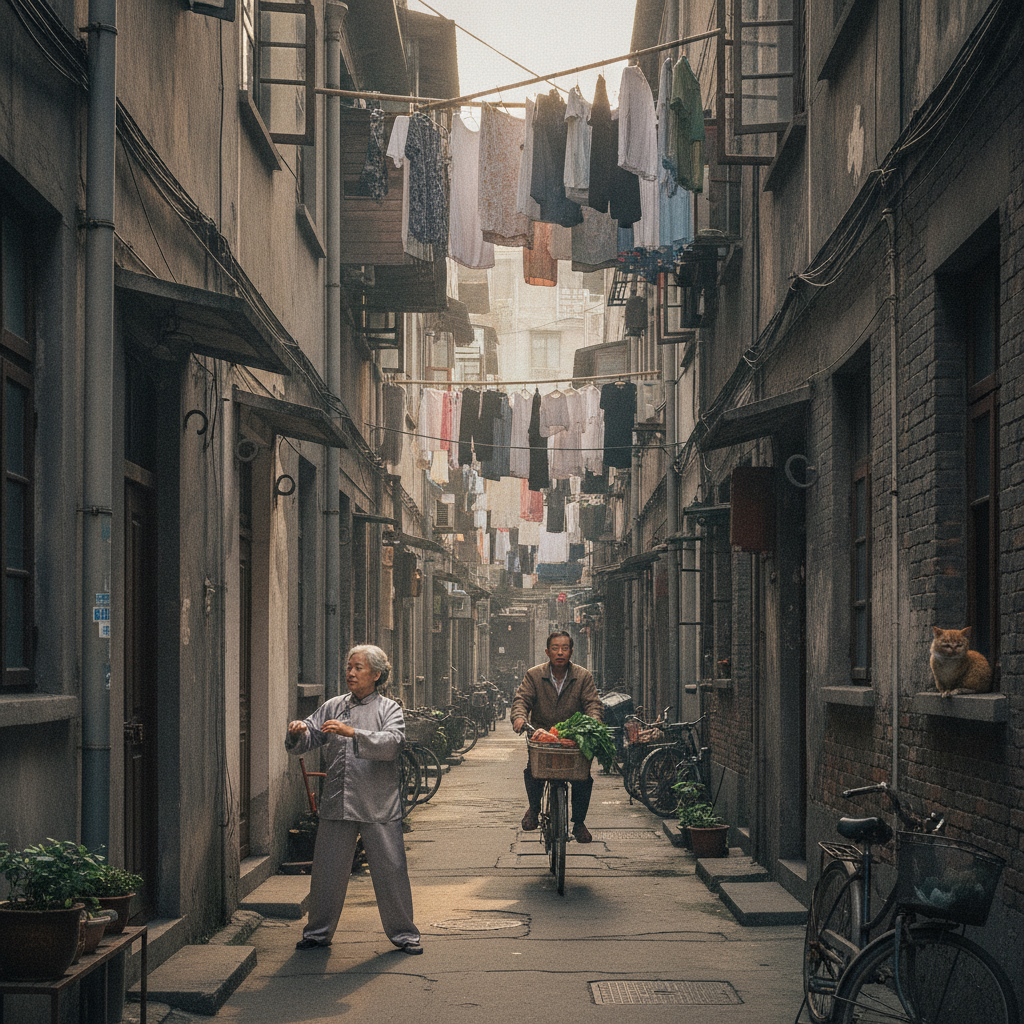
Longtang e Case a Vicolo — La Vita Quotidiana nella Vera Shanghai
Longtang (弄堂 — lòngtáng — the Shanghai term for the lilong (里弄) lane house neighbourhood, the form of dense urban housing that housed the majority of Shanghai's population from the 1870s through the 1940s and still houses millions of Shanghai residents today): the longtang neighbourhood (the block of terraced houses organized around a system of private alleys (弄堂) branching off the public street) is the defining form of Shanghai's ordinary urban landscape, quite distinct from both the grand colonial buildings of the Bund and the shikumen of the French Concession.
- 1
Shikumen — The Hybrid Architecture of Colonial Shanghai
Shikumen (石库门, 'stone-gate house', the hybrid urban housing typology developed in Shanghai 1860–1940 combining a Western rowhouse exterior with Chinese interior courtyard organization) was the housing form for 70% of Shanghai's urban population at its peak — the original shikumen blocks (built by foreign landowners for Chinese tenants, the combination producing the unique Shanghai hybrid) have been demolished at 90%+ over the past 30 years; the surviving concentrations are in the Sinan Road area (Huangpu), the Wukang Road corridor (Xuhui), and the Jing'an Sculpture Park area.
- 2
Wukang Road — Art Deco and Lane House Heritage
Wukang Road (武康路, Xuhui District, 1.1km, the 'most romantic road in Shanghai' designation from Time Out, lined with 26 protected heritage buildings including 8 Art Deco apartment buildings) is the finest single street in Shanghai for architectural tourism — the Wukang Building (the Normandie Apartments, 1924, a prow-shaped Art Deco building at the V-junction of Wukang Road and Huaihai Middle Road, a direct replica of the Flatiron Building concept applied to an apartment building), the villas of Song Qingling (the wife of Sun Yat-sen) and Barron Reza (the Iranian painter), and the Taikang Road food and art market (at the end of Wukang Road via Yongjia Road) complete the walk.
- 3
Taikang Road Art Street — The Lane House Gallery Quarter
Taikang Road (田子坊, Tianzifang, Huangpu District, the lanehouse district surrounding Taikang Road and the interior alleys Taikang Road Lane 210/248) is Shanghai's best-preserved neighborhood-scale art and craft community — the original 1930s shikumen housing blocks (now containing 200+ artist studios, craft shops, cafes, and galleries within the original lane structure) and the ground-floor shops opening directly onto the alley (ceramic studios, textile artists, calligraphy practitioners visible at work) create a living craft community; the entrance at Taikang Road (accessible from Shaanxi South Road Metro, Line 9) is free.
- 4
Xintiandi — The Boutique Hotel and Dining District
Xintiandi (新天地, Taicang Road, Huangpu, 2001, Benjamin Wood architect for Shui On Land, the preservation-and-conversion of a 25-block shikumen neighbourhood into an upscale entertainment and commercial district) is Shanghai's most debated urban development — the physical preservation (the stone gate facades, the interior brick walls, the roof tile profiles) alongside the complete replacement of the original residents (relocated to suburban blocks) makes Xintiandi the textbook case for the gentrification-preservation tension; the CCP First Congress Site (Xingye Road 76, free, open daily) is within the Xintiandi development.
- 5
Lu Xun Former Residence — The Father of Modern Chinese Literature
Lu Xun Former Residence (鲁迅故居, Shanyin Road 132, Hongkou District, free, Tuesday–Sunday 9am–5pm, the house where Lu Xun — the pen name of Zhou Shuren, 1881–1936, the most important writer in modern Chinese literature, the author of 'A Madman's Diary' and 'The True Story of Ah Q' — lived from 1933 until his death in 1936) preserves the domestic circumstances of China's most politically significant literary figure; the adjacent Lu Xun Memorial Hall (Guangzhong Road, free) and Lu Xun Park (the park containing his tomb) form a 3-part cultural circuit in the Hongkou district.
- 6
Longtang Architecture Walking Tour — Understanding the City's DNA
The longtang (弄堂, the narrow lane systems connecting the major roads, the primary spatial unit of pre-1949 Shanghai) is the key to understanding how traditional Shanghai communities functioned — the lanes (3–5m wide, running perpendicular to major streets) provided the physical infrastructure for street food vendors, barbers, laundresses, and informal commerce; the surviving longtangs of Jing'an, Huangpu, and Xuhui (approximately 200 remain from an original 1,000+) can be explored on foot using the 'Shanghai Longtang Walking Map' (available at Rockbund Art Museum shop, ¥35) which identifies 25 heritage-protected examples.