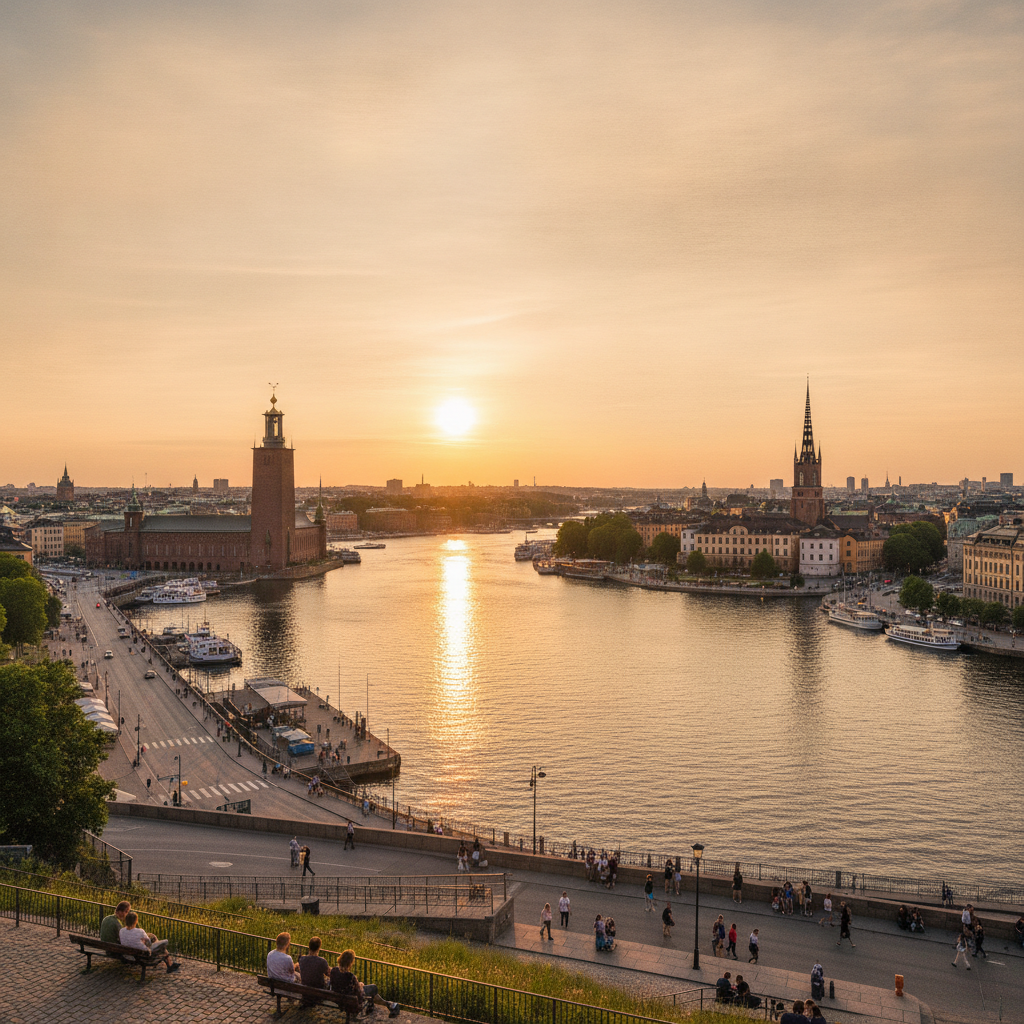
Sole di Mezzanotte, Midsommar e le Stagioni di Stoccolma
Stockholm's position at 59°N latitude (the same latitude as southern Alaska, slightly north of Moscow) gives the city one of the most dramatic seasonal cycles of any major capital city in the world: in June, the sun barely sets (the sky remains bright 24 hours a day at midsummer, with an effective 'night' of only about 3 hours of dim twilight); in December, the sun rises at approximately 8:45am and sets at 2:48pm, giving only 6 hours of daylight; Swedish culture and psychology are deeply shaped by this dramatic light cycle.
- 1
Midnight Sun — Stockholm's 18-Hour Days in June
Stockholm (59.3°N) experiences the midnight sun effect from late May to mid-July — on June 21 (the summer solstice), the sun sets at 10:05pm and rises at 3:31am, meaning the sky never fully darkens; at midnight there is a sustained blue-grey twilight (skymning) that makes June nights in Stockholm among the most beautiful in Europe; the effect is most pronounced at Djurgården (the island parks, where the evening light on the water produces the characteristic Swedish summer atmosphere described in August Strindberg's writing) and from the city's bridge viewpoints.
- 2
Polar Night and Winter Stockholm — The Other Extreme
Stockholm in December experiences only 7 hours of daylight (sunrise 8:44am, sunset 2:55pm on December 22) — the compensatory cultural response includes the most extensive Christmas market tradition in Scandinavia (Gamla Stan Christmas Market, the oldest in Sweden since 1915, outdoor from late November to December 23), the julbord season (December restaurant tradition), and the light installation season (Stockholm's public light installations — the most important in Northern Europe — transform the city January–February); the darkness forces the city's life indoors to the museums, restaurants, and theatres.
- 3
Valborg — The Spring Bonfire Night
Valborg (Walpurgis Night, April 30) is the Swedish celebration of spring's arrival — the tradition (bonfires to scare away witches, the Scandinavian folk belief associated with the April spring cleaning) is celebrated most enthusiastically in Stockholm by university students at Djurgårdsbrunnsviken (the Djurgårds canal, where thousands gather with champagne and picnics to watch the sun set late) and at Skansen (the open-air folk museum, which organizes the official Stockholm Valborg celebration with folk songs and a formal speech); the tradition is strongest at Sweden's university cities (Uppsala, Lund, Gothenburg).
- 4
Swedish Nature and Allemansrätten — The Right of Public Access
Allemansrätten (The Right of Public Access, a customary law codified in the Swedish Constitution) grants every person the right to access and use the natural landscape throughout Sweden — crossing private land (on foot, by ski, or by boat), camping for 1–2 nights on any land away from the dwelling house, picking berries and mushrooms, and swimming in any water body are all legally protected; the consequences for Stockholm residents: the archipelago's 30,000 islands are all available for camping; the countryside within 30 minutes of Stockholm has 500km of marked hiking trails; the forested city parks (Nacka Nature Reserve, 50km² immediately east of the city) are freely accessible.
- 5
Crayfish Party — The August Ritual
Kräftskivan (the crayfish party, the traditional Swedish midsummer-to-autumn seafood feast, August–September) is the most social event of the Swedish culinary calendar — the participants wear bibs printed with crayfish, party hats with crayfish, and drink snaps (aquavit) while eating cold boiled signal crayfish (kräftor, the American crayfish introduced to Sweden in 1960 after the native noble crayfish population was devastated by crayfish plague) with dill, toast Skagen (shrimp salad on white toast), and Västerbotten cheese pie; the full moon in August is the traditional date; a typical party requires 15–20 crayfish per person at ¥500–800/kg.
- 6
Gothenburg — Sweden's Second City and Archipelago Gateway (3 Hours)
Gothenburg (Göteborg, 3 hours from Stockholm by X2000 train, ¥400–800 return, Sweden's second largest city and the largest port in Scandinavia) offers the contrast to Stockholm's Baltic-facing orientation — the Gothenburg archipelago (the Bohuslän coast, 8,000 islands and skerries, the rockiest and most dramatic in Scandinavia) and the city's food scene (Feskekôrka — the Fish Church, the indoor fish market in a 1874 neo-Gothic building, the best shrimp in Sweden; Sjömagasinet, the 2-Michelin-star seafood restaurant; the Gothenburg street food of räkmacka/prawn sandwich) make it a complete day trip or weekend.