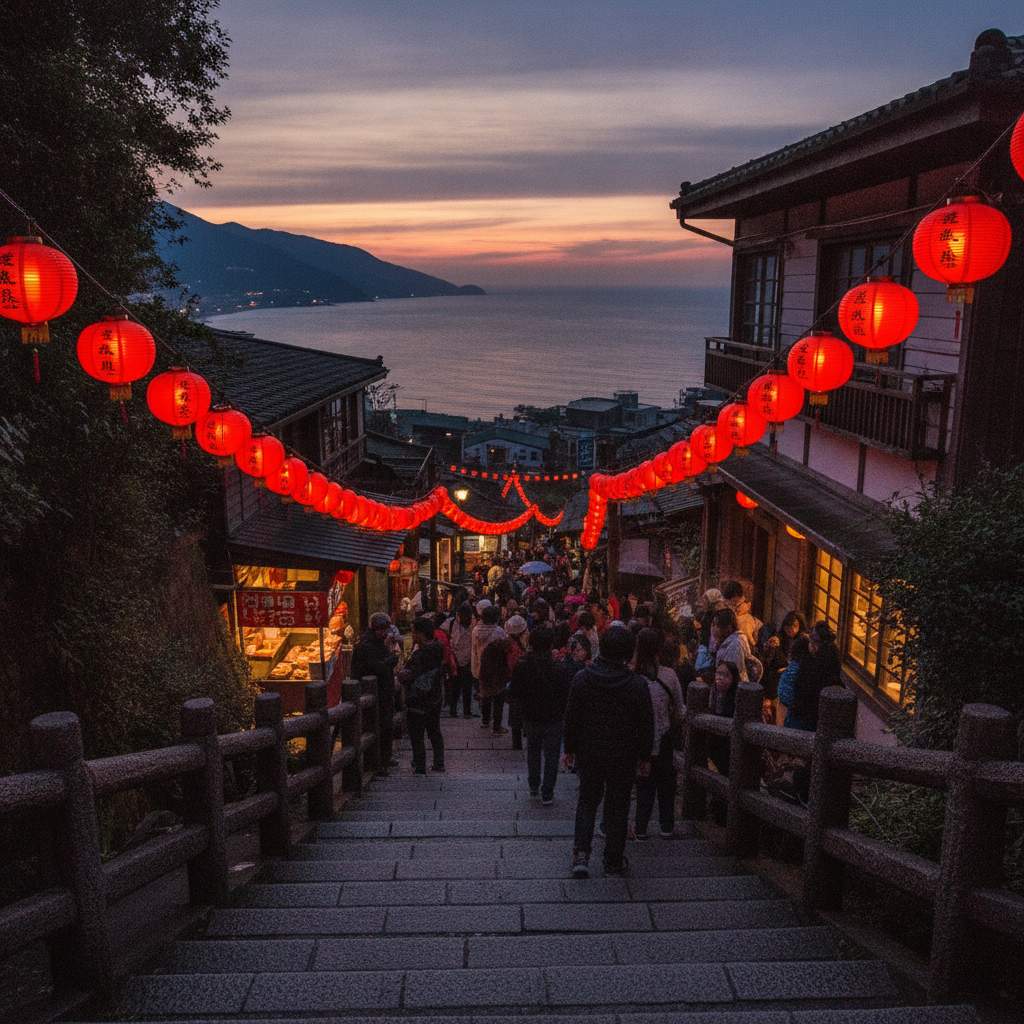
Jiufen — Il Villaggio sulla Collina che ha Ispirato La Città Incantata
Jiufen (九份 — the hillside village in the Ruifang District of New Taipei City, approximately 50 km northeast of Taipei (1 hour by bus or taxi from Taipei Main Station) — the former gold mining town that became famous internationally when Miyazaki Hayao cited it as one of the inspirations for the setting of his animated film 'Spirited Away' (千と千尋の神隠し — Sen to Chihiro no Kamikakushi, 2001, winner of the Academy Award for Best Animated Feature 2003)): Jiufen is now one of the most visited day-trip destinations from Taipei, famous for its narrow stone-stepped lanes, traditional tea houses, and the view over the Pacific Ocean coast.
- 1
Jiufen — The Hillside Town Above the Pacific
Jiufen (九份, the mountain town 45km northeast of Taipei, accessible by bus from Zhongxiao Fuxing MRT, 50 minutes, or by train to Ruifang then bus, 1 hour) is built on steep hillside terraces above the Pacific Ocean — the town (population 3,000, established by gold miners in the 1890s when gold was discovered by accident; the gold rush peaked 1930–1945 under Japanese colonial mining; mining ended 1971) is approached by the Shuqi Road staircase (the steep, lantern-hung stone staircase that is the most photographed alley in Taiwan) with teahouses and snack vendors on multiple levels.
- 2
Hayao Miyazaki Controversy — Studio Ghibli's Official Denial
Jiufen is widely credited as the visual inspiration for the 1994 Sen to Chihiro (Spirited Away, 2001) — the red-lantern teahouses on the hillside staircase and the elevated teahouse (the Jiufen Teahouse, 1997, visible from the main staircase, the most photographed building in Taiwan) are consistently compared to the spirit bathhouse in the film; Studio Ghibli has officially denied the connection (Miyazaki has said he visited Jiufen on a separate trip from the film's production), but the resemblance (acknowledged by the film's background artists as an indirect influence) drives the majority of the town's tourism from mainland China and Japan.
- 3
Gold Rush History — The Northern Taiwan Mining Coast
Jiufen's gold rush history (the Keelung Mountain gold deposits, discovered 1890, mined until 1971) is documented in the Gold Museum in Jinguashi (金瓜石, the adjacent mining town, 10 minutes from Jiufen, the site of the Japanese colonial gold and copper refinery, now a museum park with original processing equipment, ¥80) — the most significant single object: the 220kg gold brick (the largest gold bar in the world on public display) in the museum's vault; the Crown Prince Chalet (the Japanese Prince Hirohito's Jinguashi holiday villa, 1922) and the POW camp (the WWII Allied prisoner of war camp where the Japanese held Australian and British soldiers, 1942–1945) are also in Jinguashi.
- 4
Jiufen Red Lantern Teahouse Experience
The teahouses of Jiufen (the elevated restaurant-cafes on the Shuqi Road staircase and the Jiushan Street parallel alley) serve traditional Taiwanese tea (Alishan high mountain oolong, 1,500m altitude, the most fragrant tea in Taiwan; Dong Ding oolong; Oriental Beauty/Peng Feng) with traditional accompaniments (taro balls boiled in sweetened water — the Jiufen taro ball is the town's defining street food, ¥50 for a bowl; egg tarts; sweetened red bean paste) in multi-level buildings that overhang the Pacific Ocean cliff; the teahouse experience is best at dusk when the lanterns light and the Pacific horizon turns orange.
- 5
Yeliu Geopark — The Queen's Head Mushroom Rock
Yehliu Geopark (野柳地質公園, the coastal peninsula 40km north of Taipei, accessible by bus 1815 from Taipei Bus Station, ¥80 adults) is Taiwan's most distinctive geological site — the sedimentary rock formations (Miocene-era mudstone compressed and eroded by different rates to produce pedestal formations, onion skin weathering holes, and honeycomb structures) include the Queen's Head (女王頭, the 4,000-year-old mushroom rock whose stem has narrowed to 1.4m and is expected to detach within 15 years) — the Queen's Head is Taiwan's most recognized geological image and the basis of its international geological reputation.
- 6
Northeast Coast Scenic Area — Surf, Seafood, and Cliff Scenery
The Northeast Coast Scenic Area (東北角暨宜蘭海岸國家風景區, from Jiufen south to Dali, the Pacific Ocean facing coastal highway, accessible by bus from Ruifang or by cycling — the Northeast Coast Cycling Path, 36km, is Taiwan's finest coastal cycle route) passes: Fulong Beach (the largest beach in northern Taiwan, where the annual Fulong International Sand Sculpture Art Festival is held), Longdong Park (the most popular rock climbing and snorkeling site in Taiwan, volcanic sea cliffs), and the Caoling Historic Trail (the traditional path over the mountains between Ruifang and Yilan, 14km, the finest hillwalking in northern Taiwan).