Museo Nazionale del Palazzo — La Più Grande Collezione d'Arte Cinese al Mondo
National Palace Museum (國立故宮博物院 — the museum in the Shilin district of northern Taipei housing the world's largest collection of Chinese imperial art — approximately 700,000 artefacts spanning 8,000 years of Chinese civilization, the collection originally assembled by the Chinese imperial court and brought to Taiwan in 1948-1949 when the Nationalist government retreated from mainland China): the collection includes jade, ceramics, bronzes, calligraphy, paintings, and the imperial treasures of the Song, Yuan, Ming, and Qing dynasties.
- 1
National Palace Museum — The Largest Collection of Chinese Imperial Art
The National Palace Museum (國立故宮博物院, 221 Zhishan Road, Shilin District, 30 minutes from central Taipei by bus, ¥350 adults, daily 8:30am–6:30pm Friday–Saturday until 9pm) holds 696,000 artifacts from the Chinese imperial collection — the collection was transported from the Palace Museum in Beijing to Taiwan in 1948–1949 by the Nationalist government (1.2 million objects were crated and shipped in 4 phases before the People's Liberation Army captured Beijing); the three signature works (the Jade Cabbage, the Meat-shaped Stone, and the Mao Gong Ding bronze tripod, the longest inscribed bronze in existence) draw 4+ million visitors annually.
- 2
The Jade Cabbage — The Most Visited Object in Taiwan
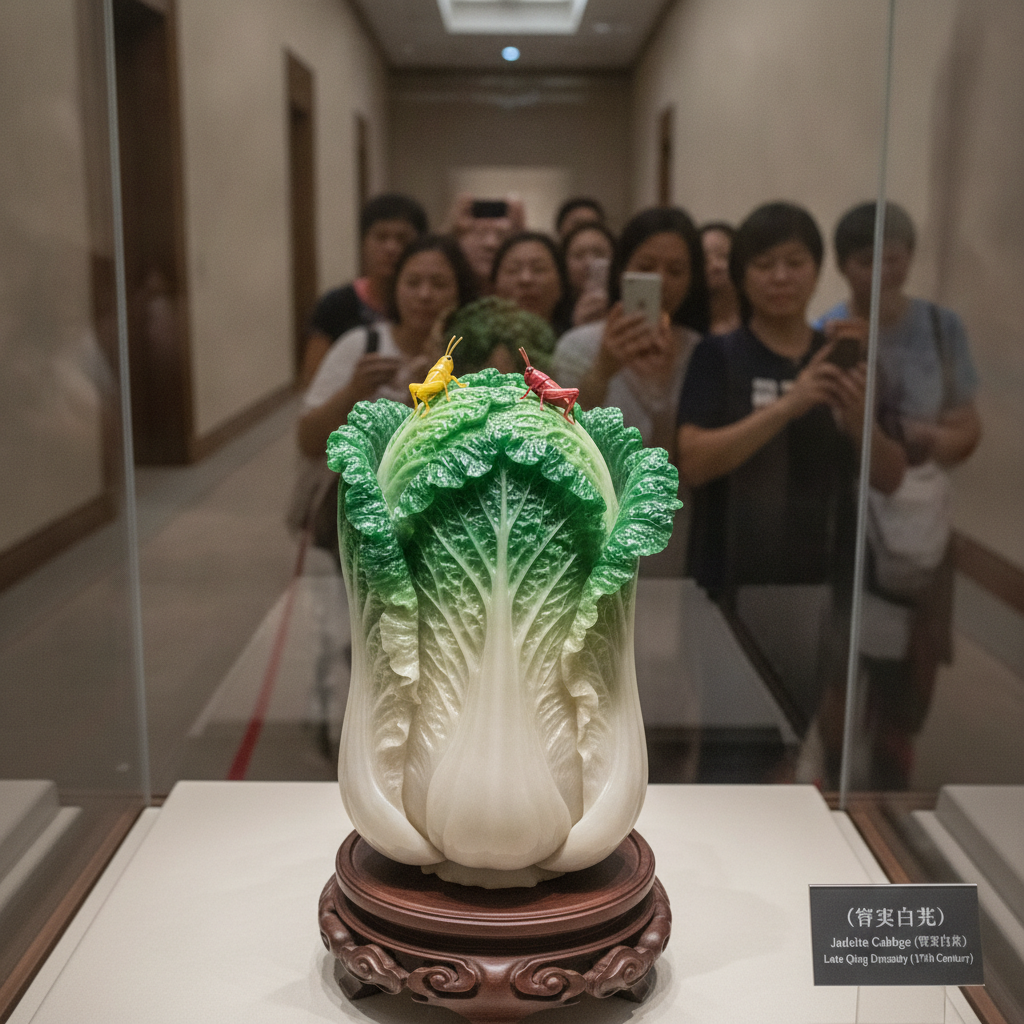
The Jadeite Cabbage (翠玉白菜, jadeite cabbage, Qing Dynasty, the material is a single piece of jadeite with natural green and white zones carved to represent a Chinese cabbage with two insects — a locust and a katydid — hidden in the leaves; 18.7cm high) is in the permanent collection gallery 302 — the object's display requires a crowd management system in peak season (queues of 40 minutes are standard July–August); the Meat-shaped Stone (東坡肉, a piece of layered jasper carved and stained to exactly replicate a portion of dongpo rou/red-braised pork belly) in gallery 305 is the second most photographed object in the museum.
- 3
Chinese Bronzes — 3,000 Years of Ritual Metal
The National Palace Museum's bronze collection (2,382 items, the most comprehensive collection of Chinese ritual bronzes outside the Mainland) covers the Shang (1600–1046 BCE) and Zhou (1046–256 BCE) dynasties — the Mao Gong Ding (the Zhou dynasty bronze cooking tripod, 832 characters of inscription, the longest text inscribed on any ancient Chinese bronze, documenting a royal award to a minister) and the Zong Zhou Zhong (the largest Zhou dynasty bell in Taiwan, 65.8cm, inscribed with the Zhou king's military victory) are the centerpieces; the inscriptions (the earliest sustained prose in Chinese) are the primary scholarly resource.
- 4
Lin An Tai Historical House — Taiwanese Colonial Architecture
Lin An Tai Historical House (林安泰古厝, Binjiang Road 5, Zhongshan District, free, Tuesday–Sunday 9am–5pm) is the finest surviving Taiwanese colonial-era residence in Taipei — the 4-section compound (built 1783–1785 by the Lin family from Fujian Province, one of the earliest settlers in Taipei basin) was relocated from its original Anhe Road site to the current location in 1978 to avoid demolition for road construction; the Minnan-style architecture (the curved saddle back roof, the red brick walls, the enclosed courtyard garden) represents the Fujian immigrant heritage that is the foundation of Taiwanese cultural identity.
- 5
Chiang Kai-shek Memorial Hall — Political Monument in Transition
The Chiang Kai-shek Memorial Hall (中正紀念堂, Zhongzheng District, free, open 9am–6pm, the giant memorial plaza with the 70m white octagonal hall containing a 6.3-metre bronze statue of Chiang Kai-shek) is Taipei's most politically contested monument — the Changing of the Guard ceremony (every hour on the hour, the most formally precise honour guard ceremony in East Asia — the soldier's face must remain completely expressionless for the 1-hour standing vigil then the 5-minute marching change) draws large crowds; the base of the memorial houses the National Theater and National Concert Hall (1987, the finest performing arts venues in Taiwan, facing across the Liberty Square plaza).
- 6
Bao'an Temple — The Most Elaborate Taiwanese Temple
Baoan Temple (保安宮, 61 Hami Street, Datong District, free, daily 7am–10pm) is the finest example of traditional Taiwanese temple architecture in Taipei — the temple (1804, dedicated to the Divine Physician Baosheng Dadi, rebuilt 1830 and comprehensively restored 1995–2002 by a UNESCO Award of Merit) is famous for its Jianzheng Competition (the traditional competition between master craftsmen on opposite sides of the temple hall, where each craftsman tries to produce superior ornamental work to his rival, visible in the asymmetric complexity of the two sides of the main hall); the Dragon Mural paintings by Chen Yucheng (2002) are the finest traditional religious painting in a working temple in Taiwan.