Hockey Hall of Fame, Maple Leafs e la Cultura Sportiva Canadese
Ice hockey is to Canada what football is to the United States or cricket to England — the defining national sport and the sport most deeply embedded in Canadian cultural identity; Toronto, as the largest city in Canada and home of the Toronto Maple Leafs (one of the Original Six NHL franchises, founded 1917), is the centre of Canadian hockey culture, and the Hockey Hall of Fame (in the historic Bank of Montreal building in the Financial District) is the sport's most sacred shrine.
- 1
Hockey Hall of Fame — The Stanley Cup on Yonge Street
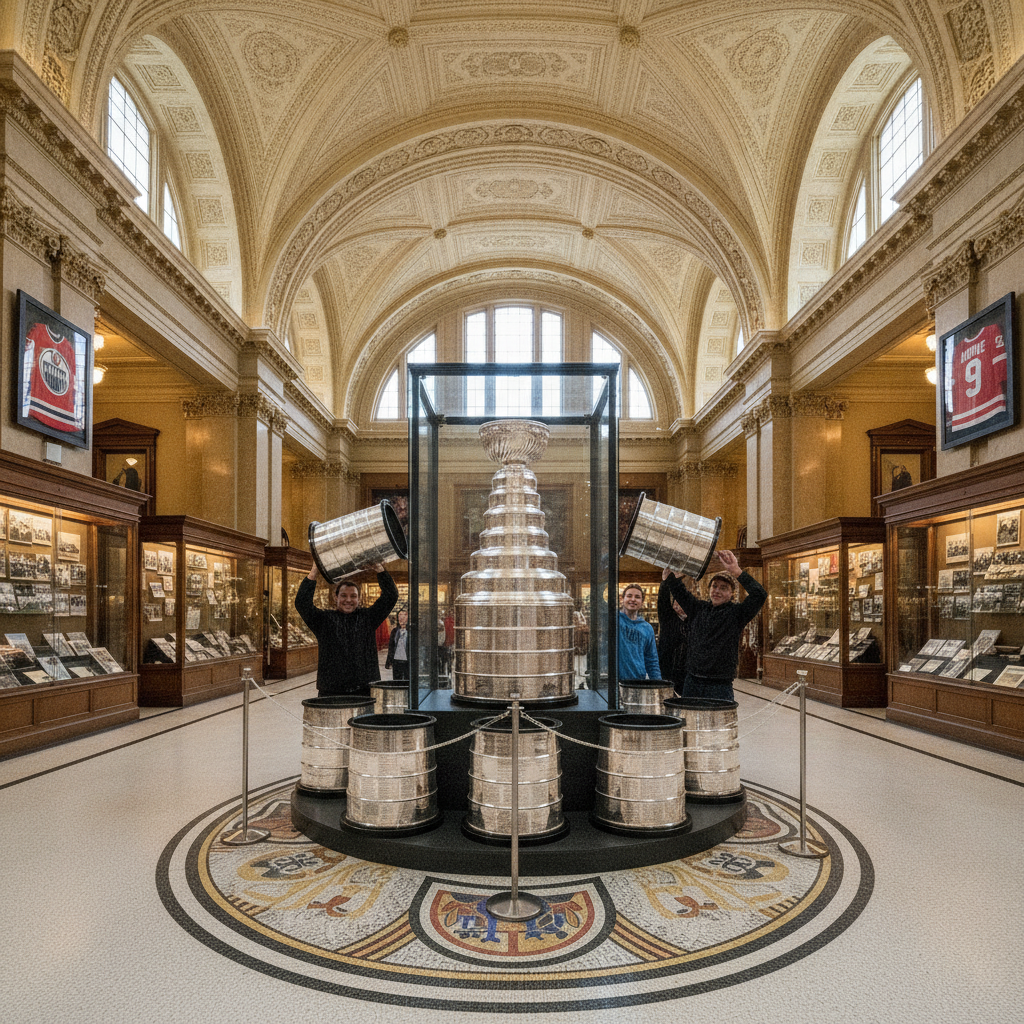
The Hockey Hall of Fame (30 Yonge Street, at the corner of Front Street, in the 1885 Bank of Montreal building, ¥25 adults, Monday–Friday 10am–5pm, Saturday 9:30am–6pm, Sunday 10am–5pm) houses the original Stanley Cup (the 1892 Dominion Hockey Challenge Cup commissioned by Lord Stanley of Preston, the original bowl now separate from the bowl awarded to the current champion — both displayed on the same floor) — the replica Stanley Cup (available for photo holding, the most popular activity in the museum), the broadcast booth simulation (calling play-by-play into the original Hockey Night in Canada set), and the Esso Great Hall (the main vault under the 1885 dome, where the Hall members' plaques are displayed) are the core experiences.
- 2
Scotiabank Arena and the Toronto Maple Leafs
Scotiabank Arena (40 Bay Street, the arena on the waterfront, opened 1999, capacity 18,819, home of the Toronto Maple Leafs NHL franchise and the Toronto Raptors NBA franchise) is the most profitable arena in the NHL — the Maple Leafs (founded 1917, 13 Stanley Cup championships — all pre-1967, the longest Stanley Cup drought of any existing original-six NHL franchise) remain the highest-valued franchise in the NHL at approximately USD 2 billion; the Rogers Centre (the SkyDome, 1 Blue Jays Way, the retractable roof stadium, home of the Toronto Blue Jays MLB franchise, the 1992 and 1993 World Series champions) is 200m away, making the downtown sports campus the most concentrated in North America.
- 3
TIFF — The Toronto International Film Festival
The Toronto International Film Festival (TIFF, the annual film festival held in September, 10 days, the largest publicly attended film festival in the world with 480,000+ attendees per year) is the most important film market outside Cannes — the TIFF Bell Lightbox (350 King Street West, the permanent 5-screen cinema and cultural centre that operates year-round outside of the festival, ¥17 regular screenings) and the festival's tradition of awarding the People's Choice Award (the audience-voted prize — 9 of the 16 Best Picture Oscar winners since 2004 first won at TIFF, including 12 Years a Slave, The King's Speech, and Green Book) make it the de facto pre-Oscar kingmaker.
- 4
Eaton Centre — The Galleria Mall and Flock of Geese
Toronto Eaton Centre (220 Yonge Street, the central Toronto shopping mall running from Queen Street to Dundas Street, opened 1977, 230+ stores, 52 million visitors per year — the most visited shopping destination in North America) is architecturally defined by Michael Snow's Flight Stop (1979, the 60-fibreglass Canada geese suspended in flight from the Victorian glass-vault ceiling of the Galleria — the installation prompted a legal dispute in 1982 when the mall decorated the geese with Christmas bows and Snow successfully sued for moral rights, the first successful moral rights case in Canadian legal history); the Galleria itself (the 11m glass barrel vault, 200m long) is the architectural centrepiece.
- 5
St. Lawrence Market — Toronto's Best Food Market Since 1803
St. Lawrence Market (93 Front Street East, the red brick market building, South Market for the permanent vendors, North Market for the weekend farmers market, ¥0 entry, Tuesday–Thursday 9am–7pm, Friday 8am–8pm, Saturday 5am–5pm) is the oldest permanent market in Toronto — the peameal bacon sandwich (cured back bacon rolled in cornmeal, served hot from the Carousel Bakery counter within the South Market — the most famous specific sandwich in Toronto, ¥8) and the market's 120+ permanent food vendors (St. Urbain Bagel, the Cheese Boutique, Mike's Fish) have made it the essential Saturday morning destination for food-focused visitors since 1803.
- 6
Chinatown and Kensington — The Spadina Corridor
Toronto's Chinatown (the primary Chinatown on Spadina Avenue and Dundas Street West, one of the largest Chinatowns in North America — Toronto has 7 distinct Chinatowns, with Scarborough Agincourt being the largest Chinese suburban community outside Mainland China and Hong Kong) and the adjacent Kensington Market (the 6-block alternative culture neighbourhood immediately north) share the Spadina Avenue corridor — the dim sum restaurants (Mother's Dumplings at 421 Spadina, the closest benchmark to Hong Kong-style dim sum in Toronto), the produce markets (the open-air vegetable sellers lining Kensington Avenue on weekend mornings), and the Scallion Pancake breakfast (the morning street food from the Chinatown bakeries on Dundas West) define the Spadina morning.