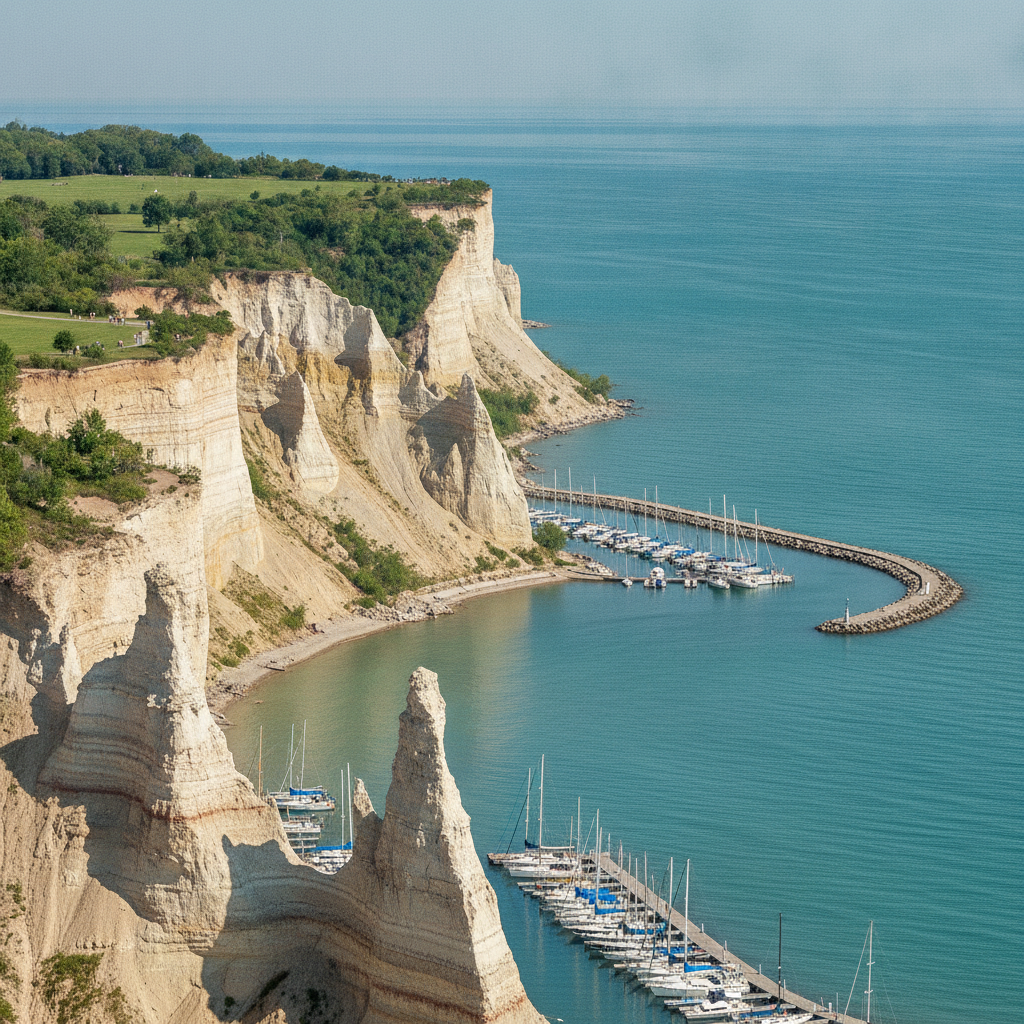
Scogliere di Scarborough, The Beaches e la Zona Est di Toronto
The Scarborough Bluffs (the 15-kilometre stretch of dramatic clay and sand cliffs rising up to 90 metres above Lake Ontario along the eastern Toronto waterfront, from the foot of Brimley Road east to the Rouge River) is one of the most spectacular natural geological features within a major North American city, and The Beaches neighbourhood (the lakefront neighbourhood of Queen Street East between Woodbine Avenue and Victoria Park Avenue) is one of Toronto's most desirable and distinctive residential areas.
- 1
Scarborough Bluffs — The 90-Metre Eroded Clay Cliffs
Scarborough Bluffs (the clay and silt bluffs extending 15km along Lake Ontario's north shore from east of the Beach neighbourhood to Port Union, up to 90m high, 12,000 years old — formed when glacial Lake Iroquois deposited sediments that have since been eroded by Lake Ontario wave action) are the most dramatic natural feature in the Toronto metropolitan area — Bluffer's Park (the park at the base of the bluffs, accessible by a steep road, the marina, the beach, and the Bluffs restaurant) provides the closest lake-level view of the cliff faces; the Cathedral Bluffs (the highest and most dramatically eroded section) are visible from the top-of-bluff parks.
- 2
The Beaches Neighbourhood — Toronto's East End Beach Village
The Beach (locally called 'The Beach', officially The Beaches, bounded roughly by Queen Street East, Woodbine Avenue, Kingston Road, and Lake Ontario) is Toronto's most consistently pleasant neighbourhood for walking — the 4km Boardwalk (the wooden lakeside walkway from Ashbridges Bay to Woodbine Beach, the most used recreational walkway in Toronto), the Queen Street East commercial strip (the independent bookshops, cafes, and restaurants that maintain the neighbourhood's village character), and the R.C. Harris Water Filtration Plant (the 1941 Art Deco/Moderne waterfront building, the most beautiful public utility building in Toronto, used as the Toronto setting in Michael Ondaatje's novel 'In the Skin of a Lion') define the area.
- 3
Distillery District — The Victorian Industrial Heritage Village
The Distillery District (the 13-acre heritage district on the former Gooderham & Worts Distillery site, 55 Mill Street, St. Lawrence neighbourhood, the largest and best-preserved collection of Victorian industrial architecture in North America, converted to arts and culture uses 2003) contains 40+ galleries, restaurants, shops, and studios within the original 1837–1870 red brick distillery buildings — the TANK House Theatre, the Balzac's Coffee (the most photographed interior in the district, the roastery in a former distillery barrel warehouse), and the annual Toronto Christmas Market (December, 650,000 visitors, the largest Christmas market in Canada) are the anchors.
- 4
Kensington Market — The Multicultural Bazaar
Kensington Market (the neighbourhood bounded by College Street, Spadina Avenue, Dundas Street West, and Augusta Avenue, Annex/Chinatown adjacent) is the most culturally layered neighbourhood in Toronto — originally a Jewish market district (1910s–1950s), then Portuguese (1950s–1980s), then the student/alternative culture anchor (1980s–present): the vintage clothing warehouses (Courage My Love, 14 Kensington Avenue, operating since 1974), the West Indian and Latin American food stores, the weekly Pedestrian Sundays (Kensington Market Pedestrian Sundays, last Sunday each month May–October, car-free, 10,000+ people) all coexist in a 6-block area.
- 5
Greektown on the Danforth — Souvlaki Mile
Greektown on the Danforth (the Danforth Avenue strip between Broadview and Jones avenues, 2km, the largest Greek commercial district in North America, served by Chester and Pape MRT stations) is Toronto's most flavourful restaurant neighbourhood — the Greek community (established 1920s, peak 80,000 Greek-Canadians in Toronto by the 1970s, now diversified) maintains 70+ Greek restaurants on the strip; the Taste of the Danforth street festival (first weekend of August, 1.7 million visitors, the largest street festival in North America) and the 24-hour souvlaki spots (the pan-flashed pita wrap souvlaki is the definitive Danforth street food, ¥8–12) are the annual draw.
- 6
Leslieville — The Hipster East End Neighbourhood
Leslieville (Queen Street East from Carlaw Avenue to Logan Avenue, and the surrounding residential streets, the east end neighbourhood that gentrified 2005–2015 from a working-class district to Toronto's highest-concentration-of-independent-restaurants neighbourhood by square metre) is the benchmark Toronto neighbourhood for independent food culture — the Ace Bakery (established 1993, the bread supplier that transformed Toronto's café standard), the Saving Grace (the weekend brunch queue that established the 2-hour brunch wait as a Toronto social ritual), and the Trinity Bellwoods Park (the park 2km west, where the White Squirrel — the piebald white squirrel colony native to the park — has become an unofficial Toronto mascot) are the anchors.