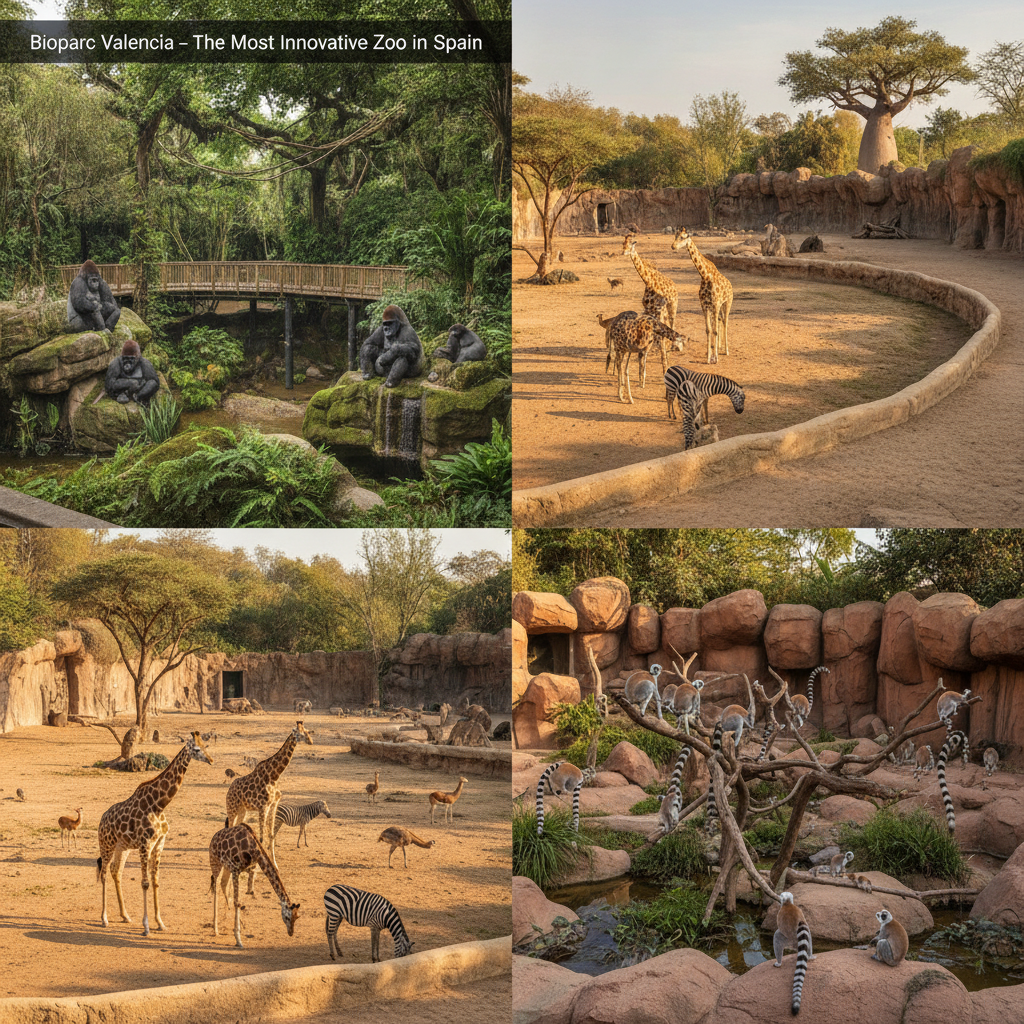
Bioparc Valencia, Parco Cabecera e la Città Moderna
The Bioparc Valencia (the innovative zoo in the western end of the Jardí del Túria — the zoo that uses the 'zoo-immersive' concept where the traditional cages and barriers between the visitor and the animal are replaced by naturalistic habitat recreations without visible barriers, creating the illusion of free coexistence between the visitor and the animals) and the Parc de Capçalera (the park at the western head of the Jardí del Túria, with the lake and the gardens that mark the beginning of the former Turia riverbed park) together anchor the western end of Valencia's extraordinary linear park.
- 1
Bioparc Valencia — The Immersion Zoo Without Bars
Bioparc Valencia (Avenida Pío Baroja 3, northwest Valencia on the western end of the Jardines del Turia, Metro Nou d'Octubre, ¥24 adults, daily 10am–sunset) is the most conceptually advanced zoo in Spain — the 'zooinmersión' concept (no visible barriers between visitors and animals — the separation is achieved by invisible barriers: moats behind foliage, glass panels recessed into rock faces, level changes) creates the impression of walking through African ecosystems; the four zones (Savannah, Equatorial Africa, Forest, and Madagascan Wetlands) contain 4,000 animals of 250 species; the gorilla habitat (the largest gorilla enclosure in Spain) and the pygmy hippopotamus pool (one of 3 in Spanish zoos) are the most visited.
- 2
Palau de les Arts Reina Sofía — Calatrava's Operatic Landmark
Palau de les Arts Reina Sofía (the opera house on the eastern end of the Jardines del Turia, opened 2005, Santiago Calatrava architect, the steel and titanium shell reaching 75m, the most visually dramatic building in Valencia) is the centrepiece of the City of Arts and Sciences complex — the opera house (1,400-seat main auditorium, 800-seat concert hall, 400-seat outdoor performance space) programs opera, ballet, and classical music from September to June; the building is accessible for free from the park at the base; the Calatrava-designed bridge (Puente de l'Assut de l'Or, the asymmetric cable-stayed bridge adjacent, 125m pylon, 2008) and the Hemisfèric (the IMAX cinema and planetarium, ¥9, in the eye-shaped building reflected in the lagoon) complete the complex.
- 3
City of Arts and Sciences — The Complete Complex
Ciutat de les Arts i les Ciències (the cultural complex in the former Turia riverbed, eastern Valencia, the largest cultural complex in Europe at 350,000m², built 1996–2009) comprises: the Hemisfèric (1998, the IMAX and planetarium), the Museu de les Ciències (2000, the interactive science museum, ¥8 adults), the L'Umbracle (the open-air garden and sculpture path, free), the Oceanogràfic (2003, the largest aquarium in Europe, 110,000m², 45,000 marine animals, ¥31 adults) and the Palau de les Arts — the Oceanogràfic (the beluga whale pool — 3 beluga whales in the Arctic pavilion — and the open-air dolphin show) is the most visited attraction in Valencia, receiving 1.4 million visitors per year.
- 4
Oceanogràfic — Europe's Largest Aquarium
Oceanogràfic Valencia (Camí de les Moreres, eastern end of the Turia riverbed, Felix Candela architect — the thin concrete shell structures over the pavilions are Candela's most ambitious late work, completed 2002, 2 years before his death, ¥31 adults, daily 10am–8pm) is organized into 10 ecosystems (Mediterranean, Wetlands, Temperate Seas, Tropical Seas, Oceans, Antarctic, Arctic, Red Sea, Islands, Sharks) housing 500 species and 45,000 marine animals — the underwater restaurant (Restaurante Submarino, the dining room inside the central coral reef aquarium with 360° fish views, ¥55–75 set menu, book 3 weeks ahead) is the most distinctive dining setting in Spain; the shark tunnel (the 35m walkthrough tank with 6 sand tiger sharks directly overhead) is the most dramatic single exhibit.
- 5
Albufera Natural Park — The Rice Paddy Lagoon and Paella Origin
Albufera Natural Park (the freshwater lagoon 10km south of Valencia, 21,000 hectares including Spain's largest lagoon — 2,700 hectares — and the surrounding paddy fields of L'Horta, accessible by bus 25 from Valencia, or by bike on the southern cycling route along the Turia river) is where paella was invented — the original Valencian paella (paella valenciana, the protected recipe: short-grain rice, chicken, rabbit, flat green beans, white beans, tomato, saffron, rosemary, cooked in a wide flat pan over wood fire — the socarrat, the caramelized rice layer at the pan base, is the mark of correct execution) originated in the rice-farming communities surrounding the Albufera lagoon; the restaurant El Palmar (the village on the lagoon's island, all restaurants serving authentic paella, minimum 2 persons, ¥15–20 per person) is the original Albufera restaurant destination.
- 6
City of Arts and Sciences — Calatrava's Cultural Complex
Ciutat de les Arts i les Ciències (the 350,000m² cultural complex in the eastern Turia riverbed, completed 2005–2009) comprises the Hemisfèric IMAX planetarium, the Museu de les Ciències (¥8 adults), the L'Umbracle garden (free), the Oceanogràfic Europe's largest aquarium (¥31 adults, 45,000 marine animals), and the Palau de les Arts opera house — Santiago Calatrava's structural expressionism (the white steel ribs, the flowing concrete forms) makes the complex as architecturally significant as its cultural programming.