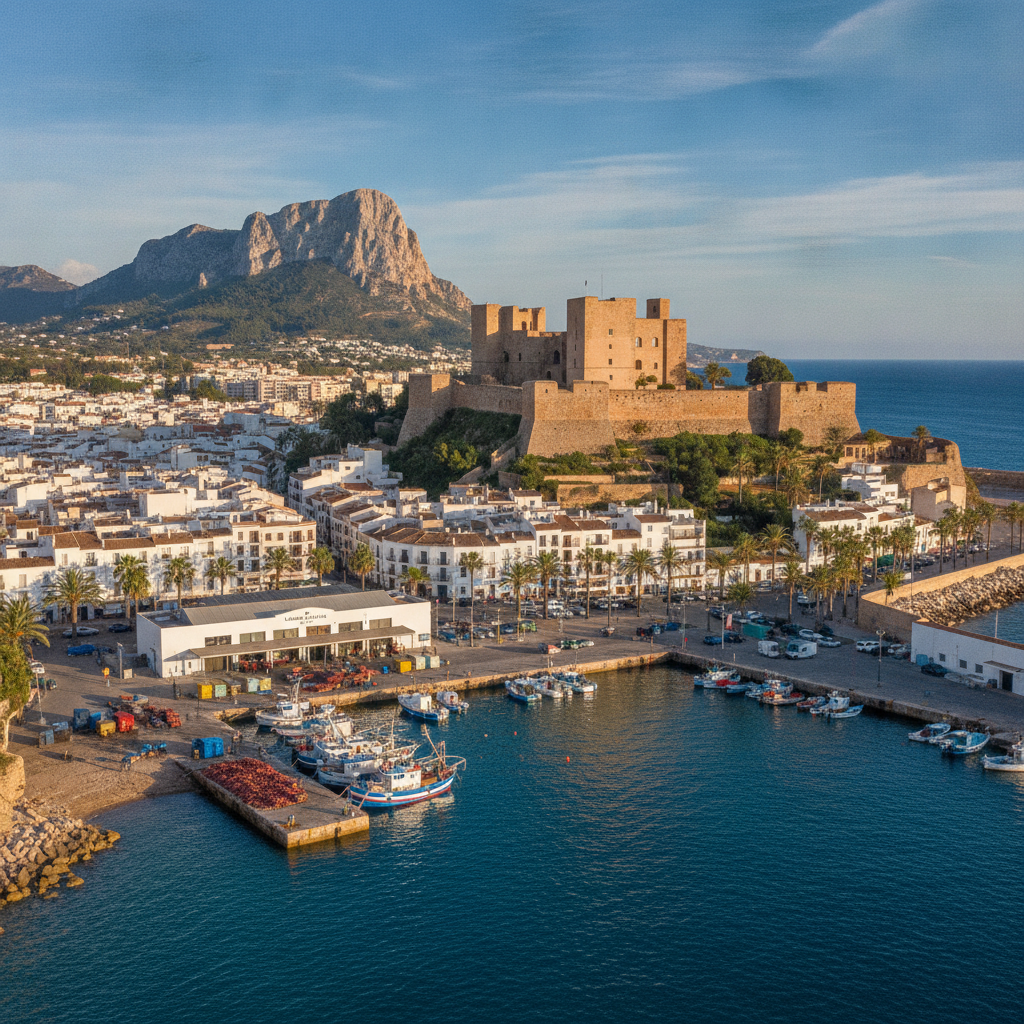
Gita Costa Blanca — Dénia, Altea e Alicante
The Costa Blanca ('White Coast' — the Mediterranean coastline of the Alicante province, 100-200 km south of Valencia) offers the most accessible day trip destinations from Valencia: Dénia (the castle town 100 km south — famous for the finest red prawns in Spain, the 'gambas rojas de Dénia'), Altea (the whitewashed hilltop village with the blue-domed church, 130 km south), and Alicante (the capital of the Costa Blanca province with the Castillo de Santa Bárbara, 170 km south).
- 1
Dénia — The Gamba Roja and the Moorish Castle
Dénia (the coastal town 100km south of Valencia, 80 minutes by Ferrocarrils de la Generalitat Valenciana tram-train, ¥5.80 one-way, the northernmost point of the Costa Blanca, a Moorish settlement with an Arab castle above the fishing port) is famous for the Gamba Roja de Dénia (the Dénia red prawn, Aristeus antennatus, caught at 400–600m depth in the Mediterranean trench offshore, the most expensive and most flavourful prawn in Spain at ¥80–120/100g) — the Michelin-starred restaurant Quique Dacosta (Las Marinas Road, 3 Michelin stars since 2012, the most creative restaurant in the Valencia region) and the dockside prawn restaurants (the grilled gamba roja, the benchmark, a la plancha at ¥35–50 per portion) define the town's culinary reputation.
- 2
Alicante — Castle, Seafront, and Rioja Wine Country Gateway
Alicante (the provincial capital 170km south of Valencia, 1 hour 15 minutes by AVE or 2 hours by Cercanías, the major city of the southern Valencia Community) is dominated by the Castillo de Santa Bárbara (the 9th-century Arab castle on the Benacantil rock, 166m, accessible by free lift from Playa del Postiguet, open daily 10am–10pm, the most visited castle in the Valencia Community) — the Explanada de España (the 1953 mosaic promenade on the seafront, 580m long, 6.5 million marble tiles in a wave pattern), the Mercado Central de Alicante (the 1921 iron market building), and the Barrio de Santa Cruz (the whitewashed Moorish neighbourhood on the castle hill) are the other essential stops.
- 3
Jávea — The Cala-Coast and Remote Mediterranean Village
Jávea (Xàbia, the coastal town between the Cap de la Nau headland, the easternmost point of mainland Spain, and the Montgó massif, 100km south of Valencia, accessible by Alicante FGV rail to Dénia then bus, 2 hours total) has three distinct zones: the old town (the fortified medieval village 2km inland, centred on the Church of San Bartolomé), the port (the working fishing harbour with the fish auction — the subasta of fresh Mediterranean fish daily at 5pm, open to the public) and the beach area (Playa de l'Arenal, the main sand beach, 3km); the Playa de la Granadella (the secluded cala with turquoise water, 6km from Jávea centre by road or 2-hour coastal walk, the most beautiful single beach in the northern Costa Blanca) requires a 20-minute downhill walk.
- 4
Tabarca Island — The Marine Reserve 40 Minutes from Alicante
Isla de Tabarca (the small island 11 nautical miles south of Alicante, accessible by Kontiki boat from Alicante port, ¥25 return, July–August every 2 hours, the only inhabited island on the Spanish Mediterranean coastline, 50 permanent residents) is a UNESCO Biosphere Reserve marine protected area — the island (1km long, 450m wide, fortified in 1768 by Charles III with a town wall that is still standing) has no vehicles; the marine reserve surrounding the island (the first marine reserve established in Spain, 1986, the sea grass meadows and Posidonia oceanica beds that are the nursery for Mediterranean fish species) produces exceptional clarity water for snorkeling (the sea floor visible at 12m depth).
- 5
Benidorm — The High-Rise Microcosm of Spanish Mass Tourism
Benidorm (the coastal resort 130km south of Valencia, 1 hour 40 minutes from Alicante by FGV tram, the most concentrated tourist resort in Europe — 2km² of beach area supporting 35,000 hotel beds and 10 million visitors per year, 45 skyscrapers above 100m) is both the most criticized and most economically successful beach resort model in the world — the Playa de Levante and Playa de Poniente (the 2 main beaches, each 3km, 50m+ wide, the finest managed beach infrastructure in Spain) and the Benidorm Palace (the 3,000-seat dinner theatre, the largest cabaret venue in the world) represent the resort's two registers; the Mirador del Castillo (the free lookout above the old town) provides the best aerial view of the phenomenon.
- 6
Xàtiva — The Borgia Pope's Birthplace
Xàtiva (the hilltop town 70km south of Valencia, 45 minutes by Cercanías C1 train, ¥3.35 one-way, birthplace of Pope Alexander VI and Rodrigo Borgia — the Borgia family's Spanish origin) is dominated by the Castillo de Xàtiva (the double castle stretching 1km along the ridge above the town, the longest castle complex in Spain, ¥2.40 adults, Tuesday–Sunday 10am–6pm) which was the most important stronghold in the Kingdom of Valencia during the medieval period — the Museo del Almodí (the town's museum in the 15th-century granary, ¥3, Tuesday–Sunday, housing the portrait of Felipe V hung upside-down as a permanent rebuke for his 1707 burning of the city) and the Collegiate Church (the 1596–1920 basilica, the most architecturally complex in the region outside Valencia city) are the other attractions.