La Gondola: Squero di San Trovaso, i Traghetti e le Imbarcazioni da Lavoro di Venezia
La góndola — el bote de remos asimérico de fondo plano que ha sido el principal medio de transporte privado de Venecia desde al menos el siglo XI — es el símbolo más reconocible de la ciudad; la góndola contemporánea mide aproximadamente 11 metros de largo, pesa unos 350 kilogramos y está construida con ocho tipos diferentes de madera.
- 1
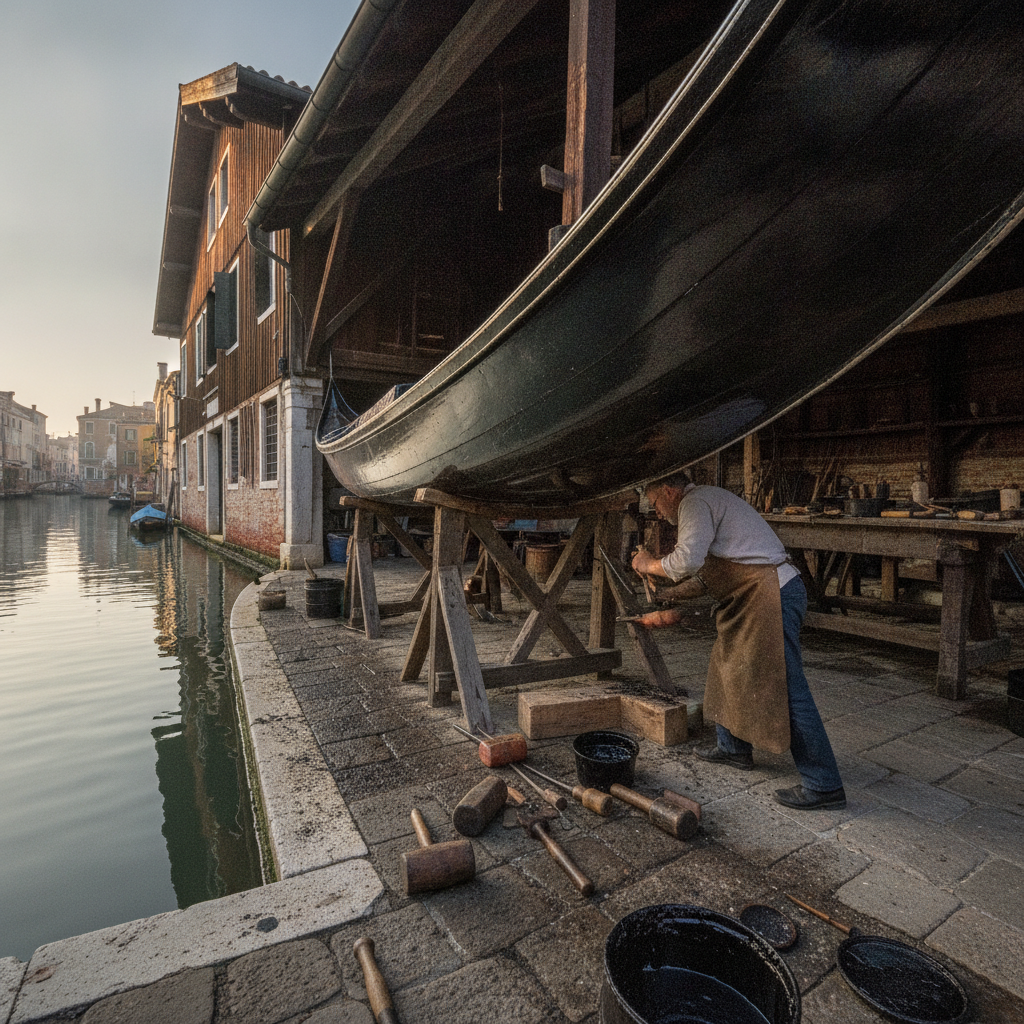
Squero di San Trovaso — The Last Working Gondola Boatyard
Squero di San Trovaso (the gondola boatyard on the corner of the Rio San Trovaso and the Rio Ognissanti, Dorsoduro, the most accessible working gondola workshop in Venice, viewed from the Fondamenta Nani opposite for free — the boatyard itself is not open to visitors) is one of the 4 remaining active gondola squeri (boatyards) in Venice, which previously had 8,000 gondolas plying the canals and now has 400+ registered gondolas; the squero (the building in the style of a mountain chalet, the master gondola builders being historically from the Cadore mountain region of the Dolomites) is most active October–April when new gondolas are built and old ones repaired.
- 2
Gondola Craft — The Asymmetric Boat Built to Turn in Circles
A Venetian gondola (the flat-bottomed, asymmetric rowboat, 10.87m long, 1.42m wide at the midpoint, the left side 24cm longer than the right — the asymmetry allowing the single oarsman standing at the stern to row in a straight line without a rudder — weighing 600kg, built from 280 pieces of 8 different woods: cherry, elm, fir, mahogany, oak, lime, walnut, and beech) requires 45–60 working days to build and costs ¥30,000–45,000 new — the forcola (the carved oarlock, each a unique sculptural form customized to the gondolier's height and style, worth ¥2,000–5,000 individually) is the only gondola component traded separately; the ferro (the iron prow ornament, the 6 teeth representing Venice's 6 sestieri) is the gondola's most recognizable element.
- 3
Gondola Ride — What the ¥80 Buys and the ¥0 Alternative
The official gondola ride (regulated by the Ente Gondola, the gondoliers' association: ¥80 for 30 minutes per gondola, maximum 6 passengers, ¥100 from 7pm–8am, the singing gondolier is an additional surcharge not included in the standard rate) is the most expensive-per-minute tourist experience in Europe — the correct route (insist on the narrow interior calli rather than the Grand Canal — the interior canals have the medieval atmosphere; the Grand Canal gondola ride is purely for the Instagram photograph); the ¥0 alternative: the traghetto (the public gondola ferry crossing the Grand Canal at 8 crossing points — ¥2 standing passenger, 5-minute crossing, the locals cross standing — functioning gondolas, functional crossing, no tourist surcharge).
- 4
Venetian Rowing — The Voga alla Veneta Traditional Style
Voga alla Veneta (the traditional Venetian standing rowing technique — the oarsman stands facing forward, rowing with a single oar in a sculling motion using the forcola oarlock, which has multiple notches for different speeds and manoeuvres — fundamentally different from all other European rowing traditions where the oarsman sits and faces backward) is practiced competitively in the Vogalonga (the 30km non-competitive rowing event held in May each year, open to all watercraft using traditional or competitive rowing — 2,000+ boats, the largest rowing event in the world by participant number) and the Regata Storica (the historical regatta, the first Sunday in September, the race of the gondolini on the Grand Canal preceded by the historical procession of the Bucintoro replica).
- 5
Venetian Masks — Carnival and the Bauta Tradition
Carnevale di Venezia (the Venetian carnival, the 10 days before Ash Wednesday, the world's oldest carnival — documented from 1094, suppressed by Napoleon in 1797, revived as a tourist event in 1979) is dominated by the mask tradition (the maschere, which in the Serenissima Republic were worn publicly from October to Mardi Gras, allowing the anonymization of social class identity) — the bauta (the white half-mask with the prominent chin that allowed eating without removing the mask, the most historically authentic Venetian mask), the moretta (the oval black velvet mask held in place by biting a button, requiring silence), and the medico della peste (the plague doctor's beaked mask, not historically Venetian but now the most internationally recognized) represent the principal types.
- 6
Murano Glassblowing — Watching the Maestro at Work
The glassblowing demonstration at a Murano furnace (the free demonstrations at Davide Penso, Fondamenta Vetrai 48, Murano, or Fornace Mian, Calle Briati, Murano — demonstrations every 30–60 minutes) shows the complete process from gather to finished object in 5–15 minutes — the key techniques: filigrana (the threading of white or coloured canes through clear glass to produce the feather-comb patterns unique to Venetian glass), sommesso (the layered glass technique producing the cameo effect), and millefiori (the thousand flowers, the cane cross-section pattern process that produces the characteristic floral patterns in paperweights and plates); the demonstration is free but the showroom is the expected commercial outcome — the Murano glass pieces are the most significant regulated craft product in Italy.