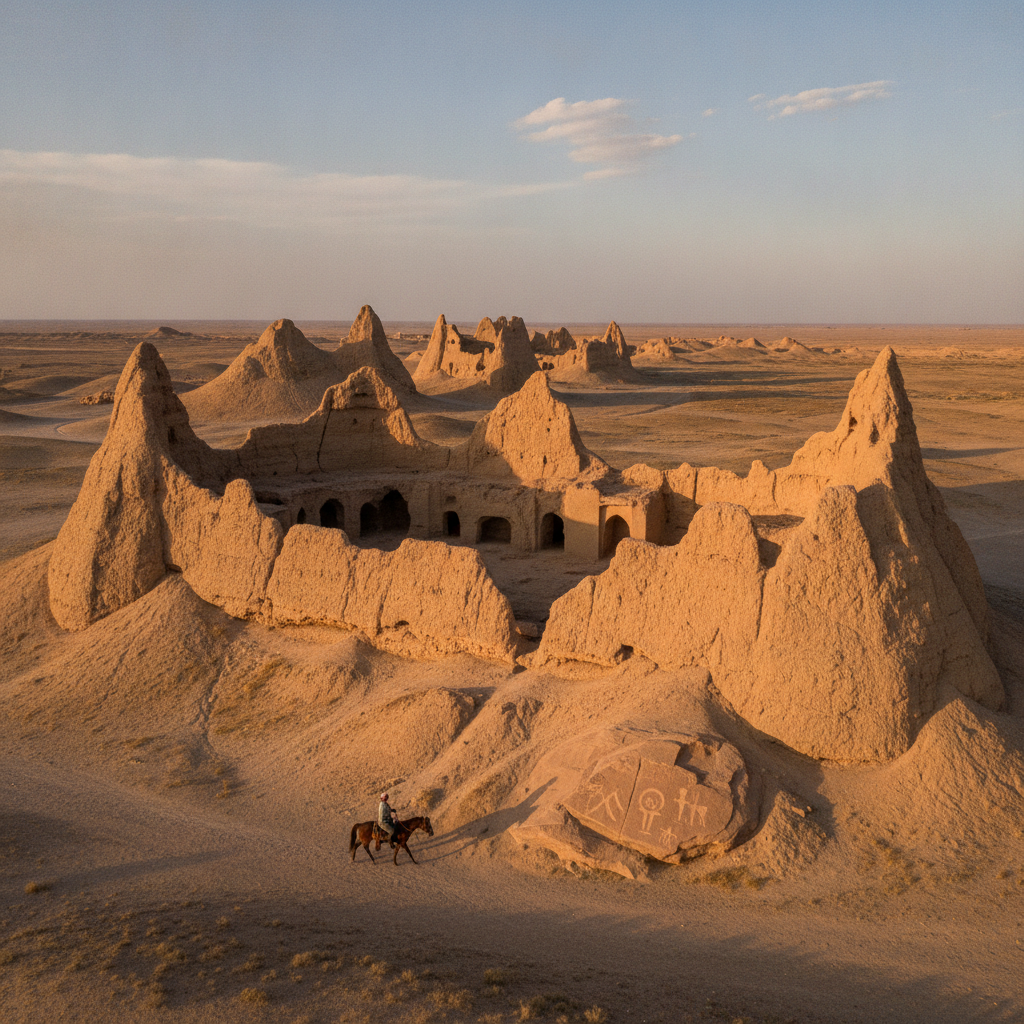


Khiva Ancient Khorezm History and Civilization
Explore the ancient history of Khorezm — the region around Khiva where one of Central Asia's earliest civilizations developed in the Amu Darya delta, the ancient Khorezmian kingdom that maintained independence from the Achaemenid Persian Empire, the homeland of the medieval Islamic scholar al-Biruni, and the state that was destroyed by Genghis Khan in 1221.

Khiva Pahlavon Mahmoud Mausoleum Pilgrimage
Visit the shrine complex of Pahlavon Mahmoud — the beloved patron saint of Khiva, a 13th-14th century poet, philosopher, and legendary wrestler whose mausoleum is the most sacred site in Khiva, the complex that has drawn pilgrims for 600 years and whose blue-tiled dome is the most photographed image of the city.

Khiva Muhammad Amin Khan Madrasa Architecture
Visit the Muhammad Amin Khan Madrasa — the largest madrasa in Khiva built in the 1850s adjacent to the unfinished Kalta Minor minaret, now converted into a hotel while maintaining its architectural character, the building representing the peak of Khorezm madrasa architecture with its elaborate tile facade and the sweeping view from its roof terrace.

Khiva Khorezm Oasis Amu Darya Agriculture
Explore the Khorezm oasis — the fertile delta of the Amu Darya river that has sustained one of Central Asia's most productive agricultural zones for 5,000 years, the ancient irrigation system expanded dramatically in the Soviet era for cotton cultivation, the oasis landscape that made the Khiva khanate one of the wealthiest in Central Asia.

Khiva Khorezm Woodcarving and Traditional Crafts
Discover the crafts of Khorezm — the distinctive woodcarving tradition that produced the elaborately decorated columns, doors, and screens of Khiva's mosques and palaces, the silk weaving of the oasis, and the embroidery and jewelry of the Uzbek and Turkmen communities of the Khorezm region.

Khiva Silk Road Caravanserai and Slave Trade
Explore Khiva's role in the Silk Road and Central Asian slave trade — the caravanserais that processed the commerce passing through the Khorezm oasis, and the city's notorious 19th-century slave market where Persian and Russian captives were sold, the abolition of which was a primary Russian justification for the 1873 conquest of Khiva.

Khiva Tash Khauli Palace and Khan's Harem
Visit the Tash Khauli Palace — the 19th-century palace complex built by Allah Kuli Khan between 1830 and 1838, the most elaborate palace in Khiva featuring a harem of over 160 rooms, the audience courtyard with its carved wooden columns, and the most spectacular tile work in the city, an example of Central Asian royal architecture at its 19th-century peak.

Khiva Ichan Kala UNESCO Walled Inner City
Explore Ichan Kala — the completely preserved inner walled city of Khiva, a UNESCO World Heritage site where the medieval urban fabric of a Central Asian Silk Road city survives intact, the mud-brick walls enclosing a dense collection of mosques, madrasas, minarets, and caravanserais that make Khiva the best-preserved historic city in Central Asia.