Ipoh Cave Temples & Limestone Hills Walk
Explore the extraordinary cave temples built into Ipoh's dramatic limestone karst hills — the Kek Lok Tong, Sam Poh Tong, and Perak Tong cave temples carved from the caverns in the limestone massifs that surround Ipoh are among the most dramatic Buddhist and Taoist temple settings in Southeast Asia, combining religious art with spectacular natural cave architecture.
- 1
Kek Lok Tong Cave Temple
Kek Lok Tong (Cave of Extreme Happiness) is the largest cave temple in Ipoh — the cavern inside the limestone hill with its stalactites illuminated by coloured lights, the Buddhist and Taoist statues installed throughout the cave chambers, and the serene garden behind the cave (visible through a dramatic natural arch at the cave's back wall) creates one of the most theatrical sacred spaces in Malaysia. The garden behind Kek Lok Tong, revealed through the natural limestone arch, is a protected turtle pond and rock garden that provides the most dramatic landscape surprise of any cave temple in the region.
- 2
Sam Poh Tong Temple
Sam Poh Tong (Three Treasures Cave) is one of Ipoh's oldest cave temples, established by a Chinese monk who meditated in the natural cavern over a century ago — the temple complex with its prayer halls installed in the cave chambers, the vegetarian restaurant serving the community of monks resident in the temple, and the turtle pond fed by the limestone spring water at the cave entrance is a functioning monastic community as well as a tourist attraction. The stalactite formations visible in the cave ceiling and the dramatic interior space of the cavern provide the most natural cave environment of any of the Ipoh cave temples, with less artificial lighting than Kek Lok Tong.
- 3
Perak Tong Cave Temple
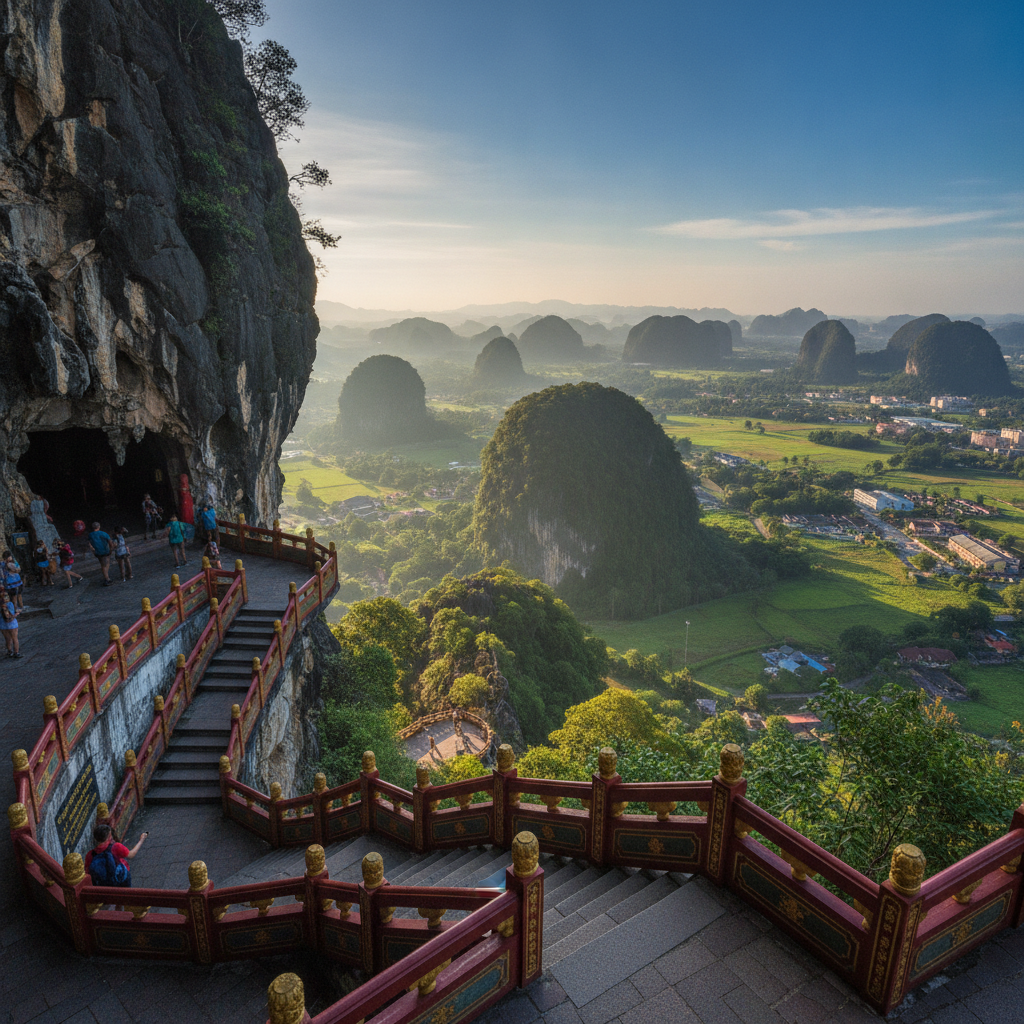
Perak Tong (Perak Cave) north of Ipoh is the most artistically significant of the region's cave temples — the cave contains over 40 Buddhist statues (including a 12-metre seated Buddha), murals painted on the cave walls depicting Buddhist cosmology and narrative scenes, and a 385-step staircase climbing to the hilltop above the cave for panoramic views of the surrounding limestone landscape. The murals inside Perak Tong were painted by Chinese artists over a period of decades from the 1950s onwards, creating an accumulative artwork of considerable historical and aesthetic interest within the cave environment.
- 4
Limestone Karst Landscape
The limestone hills that surround Ipoh are the most dramatic landscape feature of the Kinta Valley — the tower karst formations rising abruptly from the flat valley floor to heights of 100-200 metres create a geological spectacle comparable to the famous karst landscapes of Guilin in southern China or Ha Long Bay in Vietnam. The limestone formations were created over 300 million years of geological time, and the karst process of chemical dissolution by rainwater has created the cave systems that house the Ipoh cave temples in the hollowed-out interiors of the limestone towers.
- 5
Gunung Lang Recreational Park
Gunung Lang Recreational Park north of Ipoh uses the dramatic limestone hill as the backdrop for a lakeside park — the artificial lake created in the disused tin mining grounds reflects the limestone hill with its distinctive vertical walls, and the park's boat service to an island in the lake provides the most scenic close-up views of the karst formation from water level. The park's walking trails lead to the base of the limestone cliff and into one of the smaller cave systems in the hill, providing a nature park experience that combines the geological drama of the karst landscape with the peaceful lake environment.
- 6
Ipoh Cave Art Archaeological Sites
The limestone caves of the Kinta Valley contain some of the oldest archaeological evidence of human habitation in Malaysia — rock paintings, stone tools, and human skeletal remains recovered from the cave deposits around Ipoh document the presence of prehistoric communities (including the proto-Malay Negrito ancestors of the contemporary Orang Asli) in the limestone cave shelters for at least 10,000 years. The Gua Tambun rock art site near Ipoh (accessible but requiring prior arrangement) has the most extensive prehistoric rock painting collection in Peninsular Malaysia, with ochre paintings of animals and human figures that are among the most significant prehistoric art sites in Southeast Asia.
Walk this route with audio
Stories play automatically as you reach each stop — no tapping needed.