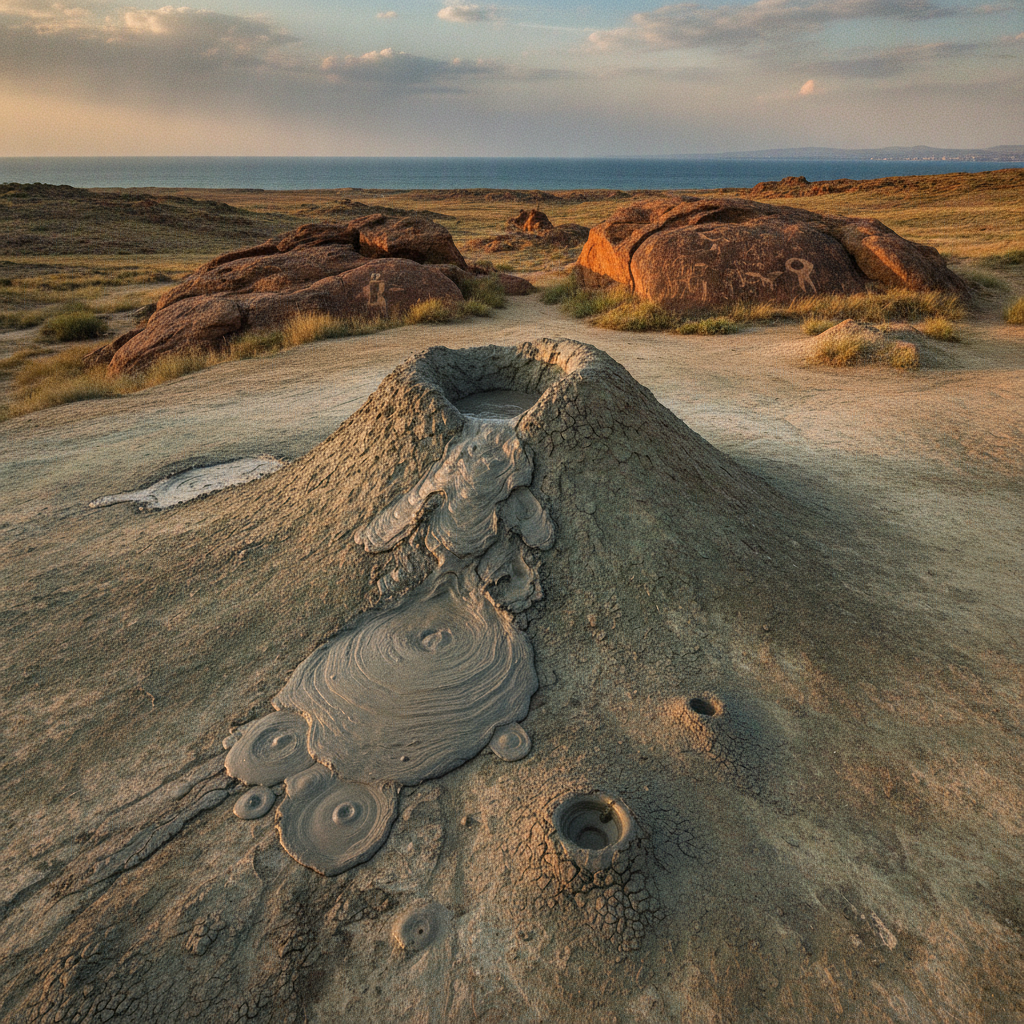


Baku Day Trips: Gobustan Rock Art, the Mud Volcanoes, the Caspian Sea, and the Most Geologically Unique Single Azerbaijan Excursion Circuit
The Baku day trips route covers Gobustan as the most comprehensively UNESCO rock-art single Azerbaijani heritage site, the mud volcanoes as the most geologically unique single Azerbaijan natural feature, and the most practically rewarding single Baku beyond-city circuit.

The Ateshgah Sacred Flame Extinguished by the 1880s Oil Drilling That Lowered Absheron Gas Pressure, the Mugham Zarb Upper Register as the Most Demanding Technical Feat in Azerbaijani Singing & the 2020 Bayraktar TB2 Drones That Reversed the 1994 Karabakh Ceasefire Line
The Ateshgah eternal flame — burning for 2,000+ years — extinguished by the 1880s oil drilling lowering Absheron subsurface gas pressure, now piped rather than natural; the mugham khanende zarb upper-register improvisation as the supreme technical achievement in Azerbaijani classical singing; the 2020 Bayraktar TB2 Turkish drones reconquering 75% of the previously occupied territory in 44 days; the Pazyryk carpet (500 BCE Scythian burial in Siberia) using identical design motifs to Azerbaijani carpets; Zaha Hadid's Heydar Aliyev Center as the most internationally recognized Azerbaijani building; and the Baku F1 circuit's 2.2km straight with 370+ km/h top speeds as the fastest single section in Formula 1.

Baku Practical: Getting There, the e-Visa, Accommodation, the Caucasus Circuit, and the Azerbaijan Visitor Framework
The Baku practical route covers Heydar Aliyev International Airport, the Azerbaijani e-visa, accommodation, the Caucasus circuit, and the complete Azerbaijan visitor framework.

Baku Essential: The Old City, Flame Towers, the Caspian Boulevard, the Maiden Tower, and the Most Dramatically Contrasting Single Post-Soviet Capital
The Baku essential circuit covers Icherisheher Old City as the most comprehensively UNESCO medieval single walled city, the Flame Towers as the most dramatically illuminated single Baku landmark, the Caspian Boulevard, the Maiden Tower, and Baku as the most dramatically contrasting single post-Soviet capital.

The Baku-Tbilisi-Ceyhan Pipeline Routed to Bypass Both Russia and Iran, Baku's 30,000-40,000 Jewish Residents as the Largest Jewish Community in Any Majority-Muslim City, and the Azerbaijan Tower Planned at 1,050m to Have Been the World's Tallest Building
The BTC pipeline (1,768 km, USD 3.9 billion, capacity 1.2 million barrels/day) specifically routed to bypass both Russia and Iran; Baku hosting the world's largest Jewish community in any majority-Muslim city (30,000–40,000 residents); the Mountain Jews' Judeo-Tat language (a Persian-derived language written in Hebrew script with Caucasian roots since at least the 5th century CE); the Azerbaijan Tower planned at 1,050m to surpass the Burj Khalifa; Baku hosting Eurovision 2012, European Games 2015, Formula 1 since 2016, and COP29 in 2024; and the September 2023 operation dissolving the Republic of Artsakh in 24 hours.

The Sheki Khan's Palace Shebeke Stained Glass Fitted Without Glue, the Piti Clay-Pot Lamb Baked 8 Hours in a Tandir, Nizami Ganjavi's Khamsa Five Poems & the Baku Boulevard Caspian Level Dropping 1.5m Since 1995
The Sheki shebeke — thousands of pieces of Venetian colored glass fitted without glue into hand-carved walnut lattice frames — inscribed UNESCO 2019; the Sheki piti lamb and chickpea soup sealed in clay pots and baked 6–8 hours in a tandir bread oven; Nizami Ganjavi's Khamsa five extended narrative poems (1141–1209) as the supreme achievement of Azerbaijani literary culture; the Baku Boulevard Caspian waterfront with the sea level dropping 1.5m since 1995; the ASAN Visa e-visa system for 95 nationalities; and the BakıKart contactless metro card at AZN 0.40 per journey.

Baku Food: Azerbaijani Plov, Dolma, Kebab, the Tea Culture, and the Most Generously Flavored Single Caucasus Cuisine
The Baku food route covers Azerbaijani plov as the most ceremonially significant single Azerbaijani dish, dolma and kebab, the Azerbaijani tea culture, and the most generously flavored single Caucasus cuisine.

Baku Architecture: The Heydar Aliyev Center, White City, the Oil-Wealth Urban Vision, and the Most Dramatically Contemporary Single Post-Soviet Architecture
The Baku architecture route covers the Heydar Aliyev Center as the most internationally significant single Zaha Hadid building, White City, the oil-wealth urban vision, and Baku as the most dramatically contemporary single post-Soviet architecture showcase.

Baku Racing: The Formula 1 Street Circuit, the Baku City Circuit, the Caspian Entertainment Scene, and the Most Dramatically Urban Single Grand Prix
The Baku racing route covers the Formula 1 Baku City Circuit as the most dramatically street-racing single European Grand Prix, the Caspian entertainment scene, and Baku as the most dramatically urban single Grand Prix host city.

The Azerbaijani Arabic-to-Latin-to-Cyrillic-to-Latin Alphabet Triple Change Unique in World Linguistic History, Black January 1990 Soviet Crackdown Killing 137 Civilians & the Armud Tea Glass Shape That Keeps the Bottom Cooler Than the Top
The Azerbaijani alphabet changed three times in the 20th century (Arabic to Latin to Cyrillic to Latin — a sequence unique in world linguistic history); the Black January 1990 Soviet military crackdown killing at least 137 Baku civilians commemorated in the Alley of Martyrs; the armud pear-shaped glass keeping the bottom third cooler than the top (allowing hot tea to be held and sipped simultaneously); the Taza Bazaar aşxana cafeteria full meal at AZN 3–7; the Gobustan rock engravings photographed in 16:00–17:00 oblique light; and the Neft Daşları Oil Rocks — the world's first offshore oil platform city built 1949, 50 km offshore in the Caspian.

Baku Oil Heritage: The Petroleum History, the Nobel Brothers, the Belle Epoque Architecture, and the Most Dramatically Oil-Transformed Single Caucasus City
The Baku oil heritage route covers the petroleum history as the most dramatically world-transformative single Azerbaijani contribution, the Nobel Brothers' role, the Belle Epoque architecture, and Baku as the most dramatically oil-transformed single Caucasus city.

Baku Culture: The Silk Road Heritage, Azerbaijani Identity, Mugham Music, the Carpet Tradition, and the Most Culturally Complex Single Caucasus Capital
The Baku culture route covers the Silk Road heritage as the most historically significant single Azerbaijani commercial contribution, Azerbaijani identity, Mugham music as the most sophisticated single Azerbaijani musical tradition, and the carpet tradition.

The Yanar Dag Natural Gas Flame That Marco Polo Saw in 1271 Still Burns at 1,000°C, Caspian Seals Down from 1 Million to 100,000 Since 1900, Gobustan's Easternmost Roman Military Inscription & the Dushbara Dumpling Test of 100 per Tablespoon
The Yanar Dag Burning Mountain natural gas seep (described by Marco Polo in 1271) still burning at 1,000°C; the Caspian seal (Pusa caspica) population collapsing from 1 million in 1900 to 100,000 today; the Gobustan rock art 40,000-year sequence including the easternmost Roman Legion inscription in the world (Legio XII Fulminata, 84–96 CE); the dushbara dumpling test of fitting 100 pieces in a single tablespoon; Yarat Contemporary Art Centre founded by Aida Mahmudova; and the 3-day circuit combining Old City, Ateshgah, Gobustan, and Sheki day trip.

Baku Drilling the World's First Modern Oil Well in 1846 Supplying 50% of Global Oil Production in 1900, the Maiden Tower With Unknown Construction Date and Unknown Function & the Nobel Brothers Who Operated the World's First Oil Tanker From the Baku Caspian
Baku's 1846 oil well preceding Pennsylvania's Drake well by 10-13 years; Baku supplying 50% of the world's entire oil production in 1900 — the highest proportion any single city has ever contributed to global petroleum; the Maiden Tower (Giz Galasi) with disputed construction date ranging from 4th century BCE to 12th century CE and completely unknown original function; the Nobel brothers (Alfred Nobel's relatives) operating the world's first oil tanker (Zoroaster, 1878) from the Caspian; the Flame Towers LED display consuming 1.5 MW of power nightly and visible 30km out to sea; and the Azerbaijani Shah plov wrapped in lavash with dried fruits and nuts.