

Udaipur's Layers: Bhil Tribal Crafts, Haveli Hotels with Lake Views & the Sanskrit Inscription That Covers 25 Ghats
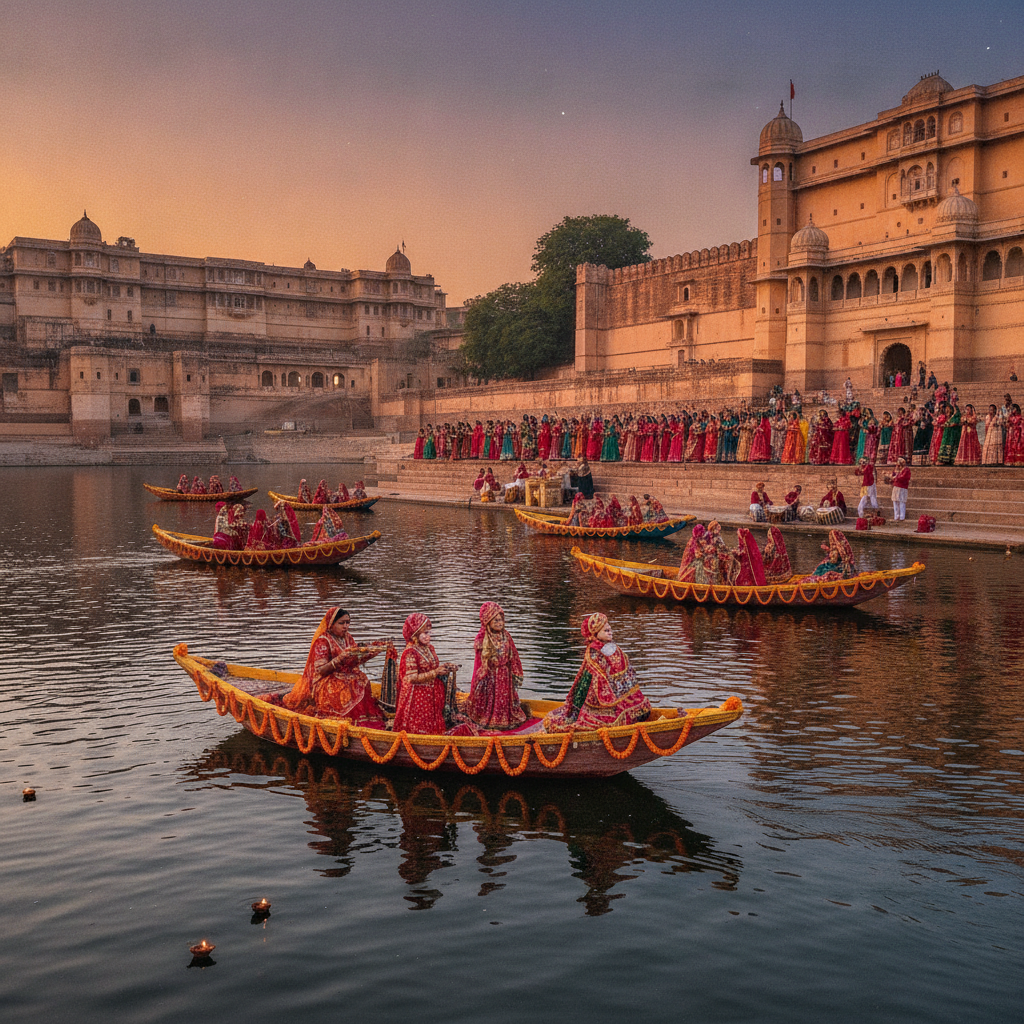
Go deeper into Udaipur—the Bhil tribe's warli-style paintings and silver jewellery from the Aravalli Hills they inhabited before the Rajputs arrived, haveli guesthouses giving lake views at ₹1,500 a night that palace hotels in other cities can't match, the Mewar Festival's boat procession of Gangaur and Issar across Lake Pichola, the Maharana's constitutional role as 'prime minister of Lord Shiva' at Eklingi Temple, and the seven-lake system engineered across six centuries where the 25-ghat Rajsamand Lake carries the longest Sanskrit inscription in India on its marble embankments.

Udaipur Essentials: Lake Pichola at Sunset, James Bond's Floating Palace Hotel & 400 Years of Mewar Architecture
Fall under the spell of Rajasthan's most romantic city—Lake Pichola's sunset boat ride with the City Palace walls turning gold above the water and the Lake Palace Hotel glowing white in the middle like a mirage, the largest royal complex in Rajasthan built over 400 years with a Peacock Courtyard of glass mosaic and Mewar miniature paintings, the island where Shah Jahan hid from his father in 1623 (possibly influencing his later Taj Mahal designs), James Bond filming Octopussy from the hotel you cannot visit without paying ₹80,000 a night, and Fateh Sagar Lake for everyone else: ₹30 boat rides and solar observatory.

Udaipur's Mewar Legacy: Maharana Pratap's Battle of Haldighati, Ranakpur's 1,444 Pillar Temple & the 36km Fort Wall
Trace the dynasty that never surrendered to the Mughals—Maharana Pratap fighting Battle of Haldighati and living in Aravalli forests for 12 years on grass chapatis rather than submit (his horse Chetak now near-mythological), the Mewar school of miniature painting with its flat red-and-blue scenes of the Ramayana developed under the dynasty's patronage, the Monsoon Palace built to watch clouds approach and never used for the purpose, Ranakpur's 1,444 marble pillars each uniquely carved (the same Makrana marble as the Taj), and Kumbhalgarh's 36-kilometre wall—the second longest in the world, built by the maharana who constructed 32 of Rajasthan's 84 forts.

Udaipur Deeper: Chittorgarh's Three Mass Self-Immolations, India's Most Spectacular Destination Wedding City & Kathputli Puppets
Confront Mewar's epic history—Chittorgarh's three Jauhar episodes when Rajput women burned themselves to death in preference to capture, the Tower of Victory with 600 deities carved across nine storeys in India's largest fort, rooftop restaurants above Lake Pichola serving laal maas with the City Palace walls reflected below, the Kathputli puppet tradition depicting Maharana Pratap and Chetak in folk performances at Gangaur Ghat, the $60 million Mittal wedding that made Udaipur famous to everyone who wasn't already a Rajasthan devotee, and the silver filigree and Mewar miniature painting workshops that sustain the old city's artisan economy.

Udaipur Dawn to Dark: Lake Light at Every Hour, Dilwara's Lace-Like Marble Carving & the Lake That Dried Out Twice
Experience Udaipur completely across a day—dawn mist on Lake Pichola when only pilgrims and fishermen are on the ghats, the Mount Abu Dilwara marble temples where stone was carved to the transparency of lace without metal tools (the finest marble carving in the world), the old city night market at Hathi Pol where silver jewellery dealers stay open until 10pm, Marwari horse rides through the Aravalli Hills with lake views, yoga on a rooftop with palace backdrop, and the uncomfortable truth that Lake Pichola dried out completely in 2004 and 2018—the floating palace sitting on cracked mud—raising the question of what Udaipur's next drought brings.

Udaipur Evenings: James Bond's Lake, Miniature Painting Workshops & the Ambrai Restaurant View Across the Water
Live Udaipur fully—the Octopussy Lake Palace Hotel location where Udaipur venues still screen the 1983 Bond film to guests, half-day miniature painting workshops in Mewar school technique with natural pigments and squirrel-hair brushes near Jagdish Temple, the Ambrai restaurant table with the City Palace lit across Lake Pichola as the definitive Udaipur dinner, sunrise over the lake from the Neemach Mata Temple steps (free, no vehicle needed, 20 minutes from the old city), water chestnut boats harvesting the floating gardens of Fateh Sagar, and Udaipur as the launch point for the Asiatic lion's only wild habitat at Gir and India's first UNESCO World Heritage City at Ahmedabad.