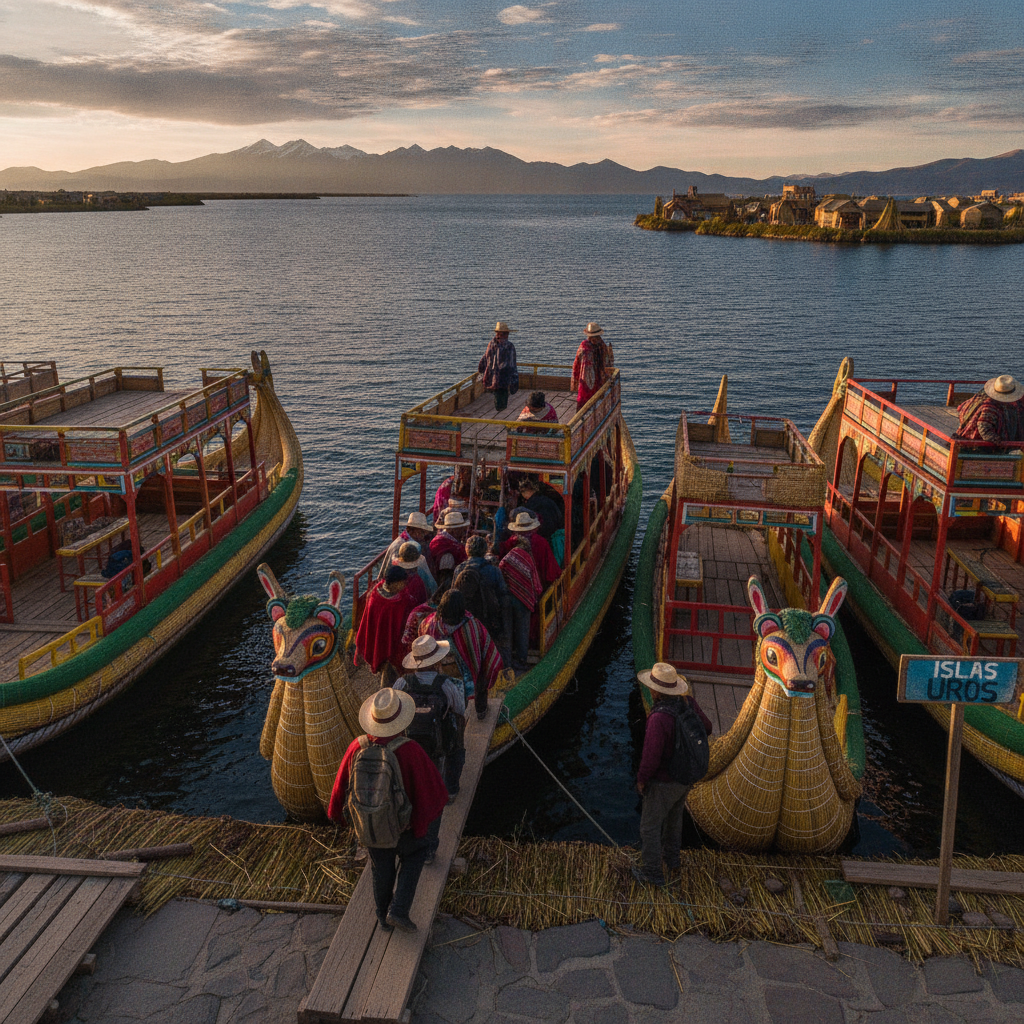


Lake Titicaca Practical Guide: Getting There, Island Visits, and Peru-Bolivia Border Crossing
Lake Titicaca straddles an international border, creating logistical complexity for travelers combining both the Peruvian and Bolivian sides. The primary Peruvian access is through Puno, reached by train from Cusco or by bus from Arequipa. The Bolivian side is accessed from La Paz via Copacabana, with the land border crossing at Desaguadero or the more scenic crossing through Copacabana and by boat. Island visits from Puno follow standard boat tour formats but the quality and authenticity vary significantly between operators. This route covers the practical decisions and logistics for getting the most from the lake.

Lake Titicaca Puno Festivals: The Candelaria and Altiplano Folklore
The department of Puno is known throughout Peru as the capital of folklore, a title earned by the extraordinary density of traditional dance, music, and festival traditions concentrated in the altiplano communities around the lake. The Fiesta de la Candelaria each February, honoring the Virgin of Candelaria who is the patron of Puno, draws over 200 dance groups from the entire region to perform in the streets over two weeks in one of the most spectacular cultural events in Latin America. The rich traditions of Aymara and Quechua music including the sikuri pan-pipe ensembles, the lakita and ayarachi styles, and the brass-dominated marching band music represent a living indigenous cultural heritage of extraordinary vitality.

Titicaca Aymara Culture: Language, Textiles, and the Living Tradition
The Aymara-speaking peoples of the Lake Titicaca basin, who number approximately 2.5 million on both the Peruvian and Bolivian sides of the border, represent one of the largest surviving indigenous language communities in the Americas. The Aymara language predates the Inca conquest of the lake region and survived Spanish colonization by maintaining its role as the daily language of the altiplano communities. The distinct Aymara textile tradition, with its bold geometric designs in vivid colors produced on backstrap and treadle looms, encodes social information about community membership and ceremonial status. The political mobilization of Aymara identity culminated in the election of Evo Morales, the first indigenous head of state in Bolivia, in 2006.

Lake Titicaca Birdwatching: Flamingos, Grebes, and Andean Waterbirds
Lake Titicaca and the surrounding altiplano wetlands support one of the richest high-altitude waterbird communities in the world. Three flamingo species, Andean, James, and Chilean, feed in the shallower alkaline margins. The critically endangered Titicaca flightless grebe, with fewer than 1,000 individuals remaining, is found only on this lake. The extensive reed beds shelter coots, grebes, rails, and herons. The adjacent altiplano grasslands and salt flats support a completely different community of plovers, seedsnipe, and Andean shorebirds. This route covers the key birdwatching sites around the lake and the species most likely to be encountered.

Lake Titicaca: The Highest Navigable Lake and the Birthplace of the Inca
Lake Titicaca, shared between Peru and Bolivia at 3,812 meters altitude on the Andean altiplano, is the highest commercially navigable lake in the world and one of the largest in South America by surface area, covering 8,372 square kilometers. The lake holds profound cosmological significance in Andean tradition: the Inca creation myth places the origin of the first Inca couple, Manco Capac and Mama Ocllo, on the Island of the Sun within the lake. The lake moderates the extreme cold of the altiplano, creating a microclimate that allows agriculture in a region that would otherwise be too cold for most crops. The Uros people construct and inhabit floating islands of totora reed in the shallower sections near Puno on the Peruvian side.

Lake Titicaca Bolivia: Copacabana, Tiwanaku, and the Bolivian Shore
The Bolivian side of Lake Titicaca, accessible from La Paz three hours by road through the altiplano, offers experiences distinct from the Peruvian side. Copacabana, the small pilgrimage town on the lake shore, is the base for boats to the Island of the Sun and a Marian pilgrimage center in its own right. Tiwanaku, the monumental site of the pre-Inca Tiwanaku civilization 70 kilometers east of the lake, is one of the most significant archaeological sites in South America and a UNESCO World Heritage designation. The lake crossing from Copacabana toward the Straits of Tiquina provides the full panoramic experience of the altiplano lake at its grandest scale.

Salar de Uyuni Connection: From Titicaca to the Worlds Largest Salt Flat
The journey from Lake Titicaca south through the Bolivian altiplano to the Salar de Uyuni is one of the great overland routes of South America, connecting two of the continents most extraordinary landscapes across 600 kilometers of high plateau. The Salar de Uyuni at 3,656 meters covers 10,582 square kilometers of perfectly flat crystalline salt, formed from the evaporation of prehistoric lakes that once covered the entire southern altiplano. The journey from Puno or Copacabana through La Paz and south to Uyuni typically takes two to three days by bus or train, passing through the mining city of Potosi, the Spanish colonial silver capital that financed the early modern global economy.

Lake Titicaca History: Tiwanaku, the Inca, and the Colonial Period
Lake Titicaca has been a center of Andean civilization for over 4,000 years. The Chiripa culture built ceremonial platforms on the lake shore before 500 BCE. The Tiwanaku civilization dominated the lake basin from 300 to 1000 CE, building one of the first urban centers in the Americas and developing the raised field agricultural system that transformed the lake margins into productive farmland. After the collapse of Tiwanaku, the lake region fragmented into competing chiefdoms including the Colla and Lupaka before Inca incorporation around 1450. The Spanish arrived in 1538 and established the encomienda system that organized the lake communities for silver mine labor at Potosi.