Battambang Tonle Sap Lake & Floating Village Walk
Visit the Tonle Sap floating villages from Battambang — the Battambang province borders the northern shore of the Tonle Sap lake, and the floating fishing communities on the lake's edge are the most accessible from Battambang of any floating village in Cambodia.
- 1
Sangker River Boat Journey
The boat journey from Battambang along the Sangker River to the Tonle Sap lake (a 4-6 hour journey through the river landscape that was the main transport route between Battambang and Siem Reap before the road network made river transport secondary) is the most historically significant river journey accessible in Cambodia — the route follows the same waterway used by the traders, the French colonial administrators, and the pilgrims travelling between the provincial capital and the Angkor temple complex for centuries. The boat's passage through the river landscape (the vegetation-lined banks, the floating villages on the river, and the transition from the narrow river channel to the open lake) provides the most complete survey of the Cambodian riverside environment accessible on a single journey.
- 2
Floating Fishing Village
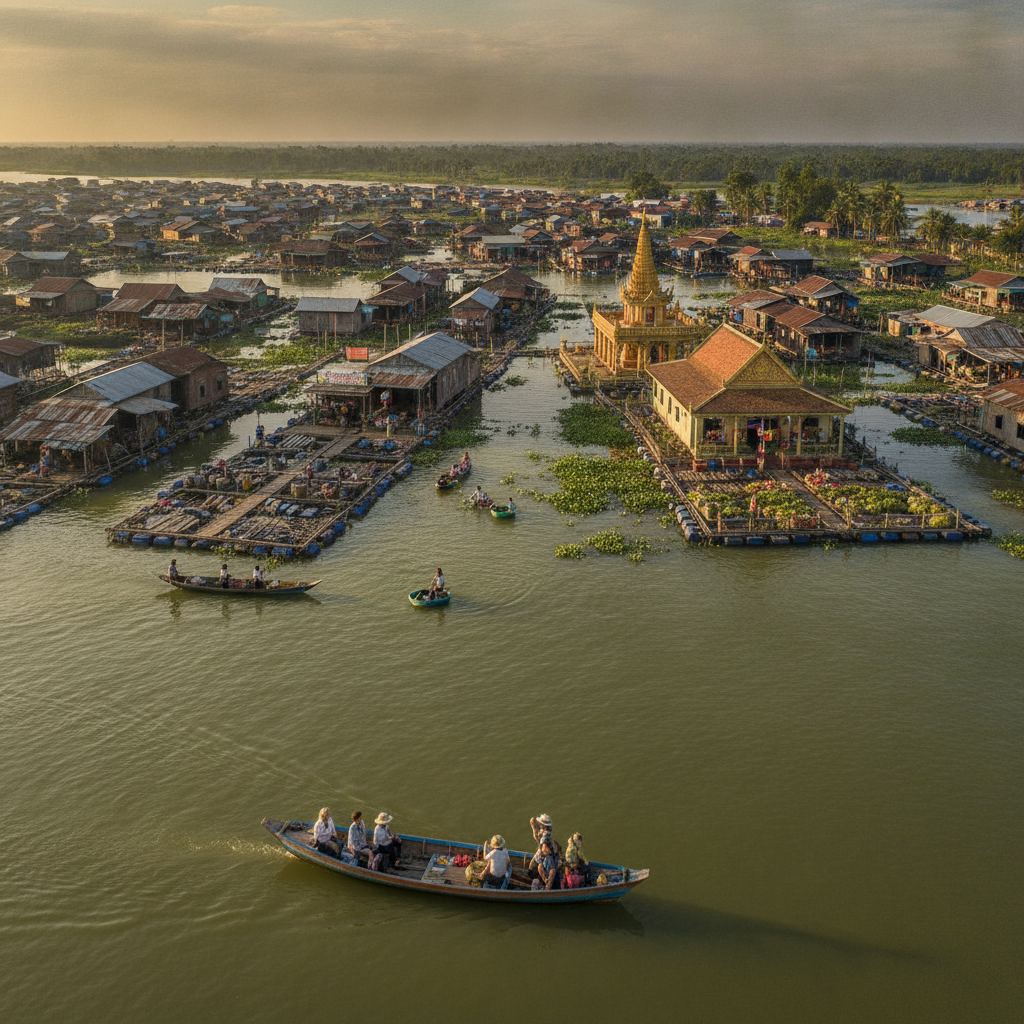
The floating fishing villages on the Tonle Sap lake (the communities living on houseboats and floating platforms on the lake's surface, permanently on the water and moving seasonally as the lake's shoreline expands and contracts with the annual flood cycle) are the most extraordinary residential environment accessible anywhere in Cambodia — the village infrastructure (the floating school, the floating pagoda, the floating market, and the floating petrol station) creates a complete community life on the water surface. The villages' predominantly Vietnamese-Cambodian ethnic composition (many of the lake's floating communities are ethnic Vietnamese who have lived on the Tonle Sap for generations, maintaining a distinct cultural identity within the Cambodian state) adds an ethnic minority cultural dimension to the ecological wonder of the lake-based lifestyle.
- 3
Tonle Sap Bird Sanctuary
The Prek Toal Bird Sanctuary on the northwestern shore of the Tonle Sap lake (accessible by boat from the floating villages) is the most important waterbird breeding colony in Southeast Asia — the sanctuary's flooded forest (the seasonally flooded gallery forest at the lake's edge that provides nesting habitat for the large waterbird species) supports breeding populations of the spot-billed pelican, the painted stork, the milky stork, the lesser adjutant stork, and the critically endangered greater adjutant stork. The bird sanctuary's peak season (December through March, when the nesting activity is at its height and the large wading birds visible in the flooded forest canopy create the most spectacular wildlife observation accessible in Cambodia) coincides with the dry season's low water levels that make the sanctuary most accessible by small boat.
- 4
Lake Fishing Methods
The traditional fishing methods of the Tonle Sap lake communities (the bag nets, the lift nets, the seine nets, and the fish corrals that exploit the lake's extraordinary fish productivity — the lake is the most productive inland fishery per unit area in the world, yielding an estimated 500,000 tonnes of fish annually) are visible throughout the lake surface and the river channels — the most dramatic single fishing method observable is the large bag net (the dai net, the massive conical net suspended in the river current to intercept the fish migrating between the lake and the Mekong system as the water levels change seasonally). The Tonle Sap fishery's productivity (supporting the primary protein source for 50% of Cambodia's population through the dried, fermented, and fresh fish products distributed throughout the country) is the most important single ecological fact about Cambodia's food security.
- 5
Mangrove Forest Boat
The seasonally flooded forest at the Tonle Sap lake edge (the flooded gallery forest and the submerged tree communities that provide critical habitat for the fish breeding that maintains the lake's extraordinary productivity) provides the most atmospheric boat journey accessible from the lake's floating village communities — the boat passage through the flooded forest (between the tree trunks, under the overhanging branches, and past the bird nests visible in the canopy above) during the high water season (October-November) creates a navigation environment that resembles the iconic floating forest images associated with the Myanmar Inle Lake but on a much more expansive and ecologically significant scale.
- 6
Tonle Sap Sunset Boat
The Tonle Sap lake at sunset (the transition from the afternoon's harsh light to the golden hour that transforms the flat lake surface into a mirror for the sky) is the most spectacular natural visual experience accessible during the dry season from any position on the lake — the flat horizon of the lake (no hills visible in any direction, just the water surface extending to the edge of sight), the silhouetted fishing vessels visible against the coloured sky, and the reflections of the sunset clouds in the still water create a visual environment of extraordinary tranquillity that is completely unlike any other sunset available in Cambodia. The boat return to the floating village at dusk (the village lights appearing on the water as the sky darkens) provides the most evocative conclusion to the Tonle Sap experience.
Walk this route with audio
Stories play automatically as you reach each stop — no tapping needed.