The Romans Captured a Beached Carthaginian Quinquereme and Built 120 Copies in 60 Days to Create the Navy That Won the First Punic War; Augustine of Hippo Wrote the First Autobiography in Western Literary Tradition (Confessions, 397 CE) Having Studied Rhetoric in Carthage; Cato the Elder Reportedly Ended Every Senate Speech With Carthage Must Be Destroyed After Returning With Fresh Carthaginian Figs to Show the Senate How Close Carthage Was to Rome
Romans capturing a Carthaginian quinquereme and building 120 copies in 60 days; the Battle of the Aegates Islands (241 BCE) being confirmed by a bronze ship ram discovered by archaeologists in 2012; Augustine writing the first Western autobiography (Confessions, 397 CE) after studying in Carthage; Cato the Elder ending every Senate speech with Carthage must be destroyed after returning with fresh Carthaginian figs; the Battle of Zama (202 BCE) where Scipio used lanes in his formation to funnel Hannibal's war elephants to the flanks; and the Mago agricultural treatise as the only major surviving Carthaginian text (28 books on farming).
- 1
Hannibal's Navy – Carthaginian Maritime Power and the Battle of the Aegates
The Carthaginian navy (the naval arm that made Carthage the dominant power in the western Mediterranean for 300 years and the fleet whose defeat ended Carthaginian power): the maritime history guide. The Punic warship (the Carthaginian warship — primarily the quinquereme (a galley with 5 banks of oarsmen — the largest class of oared warship in the ancient Mediterranean: each quinquereme had approximately 270 oarsmen, 30 sailors, and 120 soldiers: the quinquereme was introduced to naval warfare by Carthage or one of its Sicilian rivals in the 4th century BCE: the Roman naval response (at the start of the First Punic War (264 BCE) Rome had no significant navy: according to Polybius the Romans captured a beached Carthaginian quinquereme and used it as the model for building 120 Roman copies in 60 days: the Romans added the corvus (a boarding ramp with a spike) to allow Roman soldiers to board and fight in naval combat — transforming naval warfare from ramming to boarding: the Battle of the Aegates Islands (241 BCE — the decisive naval battle that ended the First Punic War: the Roman consul Gaius Lutatius Catulus commanded a fleet of 200 warships off the Aegates Islands (near western Sicily): the Carthaginian fleet of 250 ships was intercepted while carrying supplies and reinforcements to their Sicilian garrisons: the Roman victory destroyed 50 Carthaginian ships and captured 70: Carthage sued for peace: the Carthaginian navy rebuilt (despite the First Punic War defeat Carthage rebuilt its navy and used it effectively in the Second Punic War: Hannibal's sea crossing from Spain to Italy in 218 BCE required naval protection: the Punic warship discovery (in 2012 archaeologists from the Sicilian Soprintendenza del Mare discovered a bronze ram (rostrum) from a Punic warship at the site of the Battle of the Aegates Islands — the first direct archaeological evidence of the battle).
- 2
Baal Hammon and Tanit – The Gods of Carthage
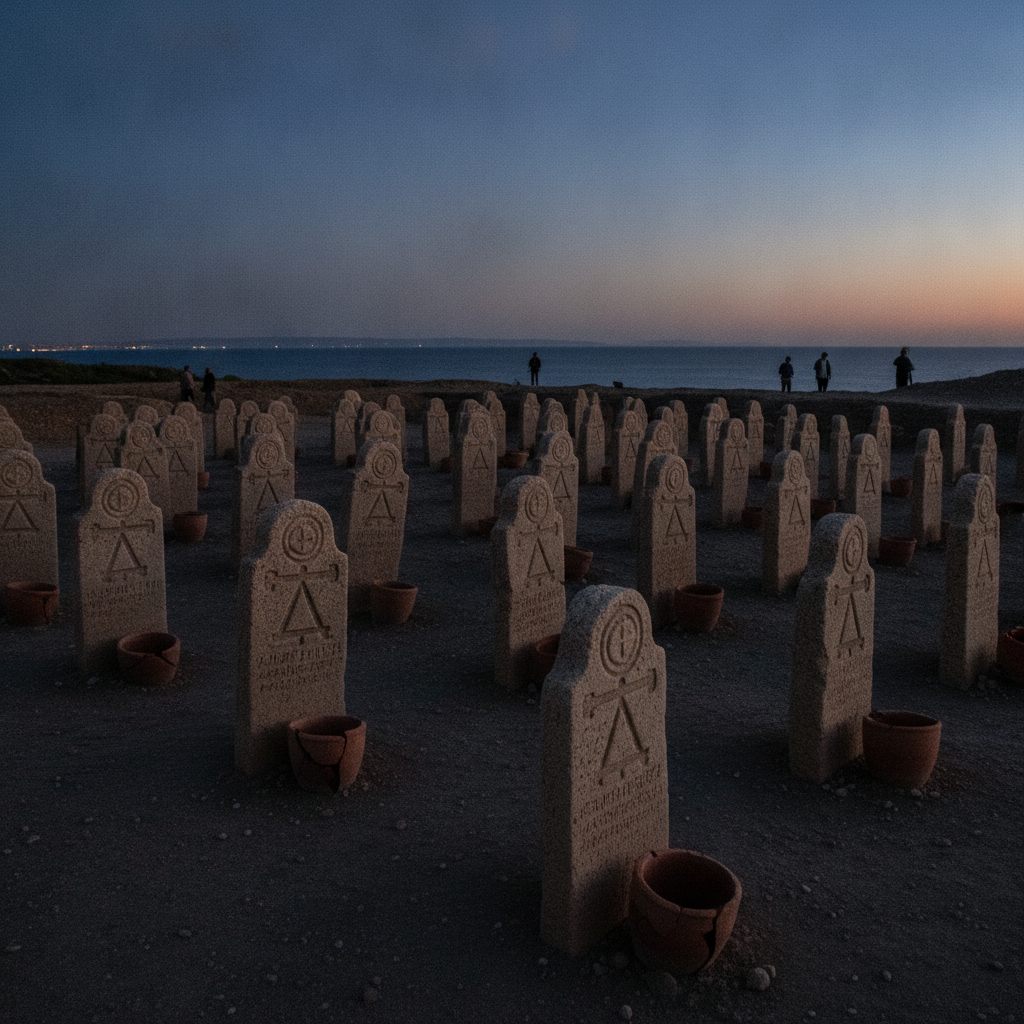
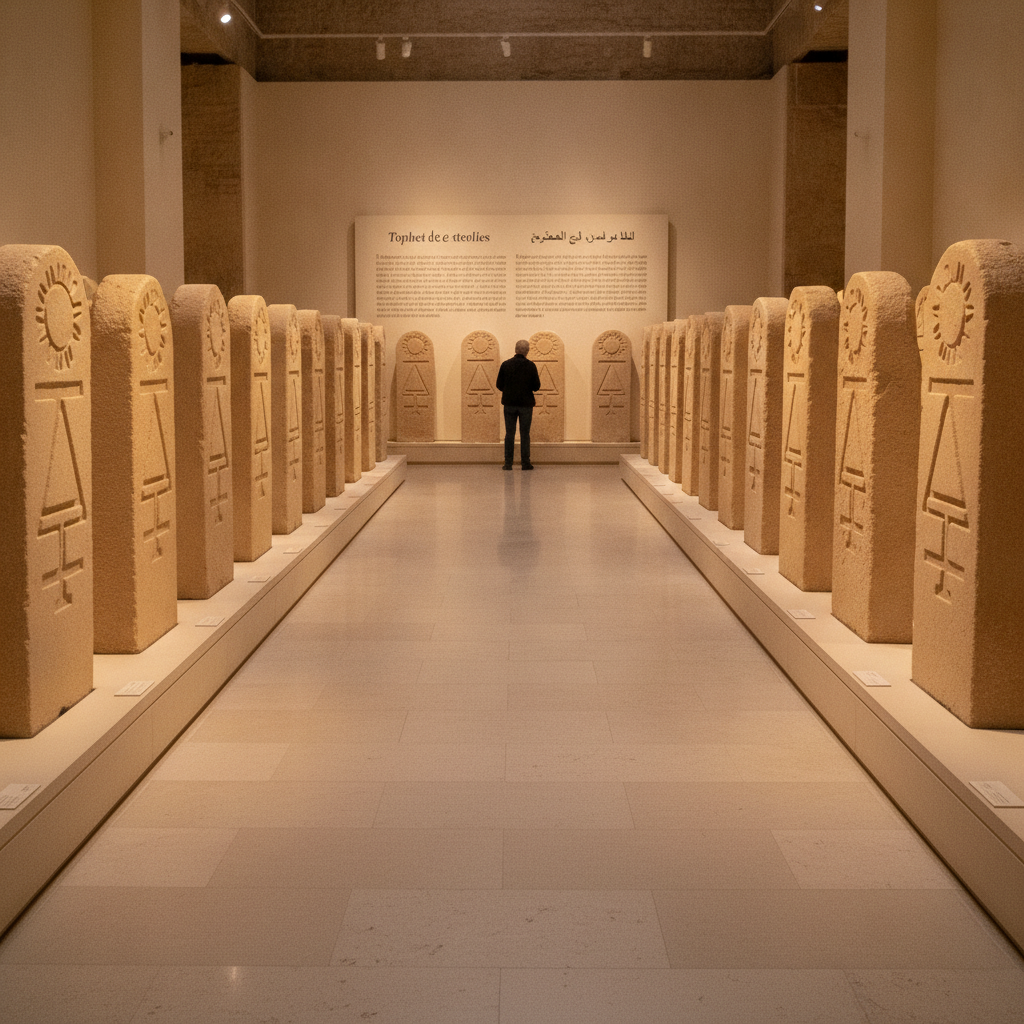
The Carthaginian religion (the theology of the major Punic deities — Baal Hammon, Tanit, Eshmoun, and Melqart — and their relationship to the Phoenician religious tradition): the religion guide. Baal Hammon (Baal Hammon (Lord of the Incense Altar — from ba'al: lord, and hammon: possibly incense altar or the deity of the sun): the primary male deity of Carthage: the patron god of Carthage alongside Tanit: associated with fertility and vegetation: depicted in Punic art as a bearded seated figure wearing a high conical crown and holding a staff of office: the parallel with the Phoenician El (Baal Hammon is identified with the Phoenician creator god El in most scholarly analyses): the Greek-Roman interpretation (the Greeks identified Baal Hammon with Kronos (the titan who devoured his children — reinforcing the ancient child sacrifice accusations against Carthage): the Romans identified Baal Hammon with Saturn: Tanit (Tanit (the Lady — Punic: Tnt): the primary female deity of Carthage: the patron goddess alongside Baal Hammon: the Sign of Tanit (a triangular figure with outstretched arms and a circle (disc) above — the most commonly used symbol in Punic religious art: appears on thousands of stelae and amulets throughout the western Phoenician world: the Greek-Roman identification (Tanit was identified with the Greek Persephone and the Roman Juno Caelestis — Juno Caelestis became one of the most widely worshipped goddesses of Roman North Africa: Eshmoun (the Punic god of healing — equivalent to the Greek Asclepius: the primary temple of Eshmoun was at Sidon in Lebanon (the temple of Eshmoun at Sidon is better preserved than any Carthaginian temple): Melqart (the divine protector of Tyre (the Mother City) — worshipped in Carthage as the founding deity of Phoenician colonization: identified with Heracles by the Greeks and Hercules by the Romans).
- 3
Scipio Africanus vs Hannibal – The Battle of Zama 202 BCE
The Battle of Zama (202 BCE) — the decisive battle of the Second Punic War that ended Carthaginian power and established Roman dominance of the western Mediterranean: the battle guide. The background (after Hannibal's brilliant campaign in Italy (218-203 BCE) in which he won three devastating victories but failed to capture Rome, the Roman general Publius Cornelius Scipio took the war to Africa: Scipio had learned from Hannibal's tactical methods during the Italian campaign: Scipio's African campaign (204-202 BCE): Scipio landed in North Africa in 204 BCE with approximately 35,000 men: Scipio allied with the Numidian king Masinissa whose cavalry was crucial to the subsequent battles: the battle (the Battle of Zama (202 BCE — location approximately 120 km southwest of Carthage near modern Zama Regia): the armies: Hannibal commanded approximately 36,000 infantry and 4,000 cavalry (including 80 war elephants): Scipio commanded approximately 34,000 infantry and 6,000 cavalry (including Masinissa's powerful Numidian cavalry): Hannibal deployed his war elephants in front of his infantry lines to break the Roman formation: the Roman response (Scipio had prepared for the elephants: he arranged his legions in columns with lanes between them: the elephants charged through the lanes and were funneled to the flanks: the cavalry (Scipio's Numidian cavalry under Masinissa defeated Hannibal's Numidian cavalry and pursued them from the field: Scipio's Roman cavalry drove off Hannibal's allied cavalry: the decisive moment (Scipio's cavalry returned from the pursuit and attacked Hannibal's rear: caught between Scipio's infantry in front and his cavalry behind Hannibal's veterans fought to the last: approximately 20,000 Carthaginians killed: the peace terms (the Peace of Zama imposed on Carthage: Carthage surrendered its Spanish territories: Carthage surrendered its fleet: Carthage was prohibited from making war without Roman approval: Hannibal escaped from the battle and later fled into exile).
- 4
Augustine of Hippo – The North African Who Shaped Western Christianity
Augustine of Hippo (354-430 CE) — the North African bishop and theologian whose writings shaped Western Christianity, Western philosophy, and the Western legal tradition for 1,600 years: the biography guide. The biography (Augustine of Hippo (Aurelius Augustinus Hipponensis) was born in Thagaste (modern Souk Ahras in eastern Algeria) on November 13, 354 CE: his father Patricius was a pagan Roman magistrate: his mother Monica was a devout Christian (later canonized as Saint Monica): the Carthage education (Augustine was sent to Carthage to study rhetoric at approximately age 17 (371 CE): Augustine describes his early years in Carthage in his Confessiones (Confessions) as a period of sexual licentiousness and philosophical seeking: the Confessions (I was in love with love... I sought what I might love, in love with loving): the Manichaeism (Augustine became a Manichee (a follower of the dualist religion founded by the Persian prophet Mani) for 9 years in Carthage and later in Rome and Milan: the conversion (Augustine converted to Christianity after hearing the bishop Ambrose of Milan preach: he was baptized by Ambrose in Milan on the night of April 24-25, 387 CE: the Confessions (the Confessiones (397-400 CE) — Augustine's spiritual autobiography: the first autobiography in the Western literary tradition: addressed to God in direct second-person address (You made us for yourself, and our heart is restless until it repose in Thee): the Confessions are still widely read and are considered one of the greatest works in Western literature: the City of God (De Civitate Dei — 413-426 CE): Augustine's response to the charge that Christianity was responsible for the Sack of Rome by the Visigoths in 410 CE: the 22-book work distinguishes between the earthly city (the state) and the Heavenly City (the Church): the City of God laid the theological foundation for the medieval Christian concept of the state).
- 5
Delenda Est Carthago – The Third Punic War and Rome's Most Debated Decision
Delenda est Carthago (Carthage must be destroyed) — the phrase attributed to the Roman senator Cato the Elder and the political campaign that led to the Third Punic War and the total destruction of Carthage in 146 BCE: the political history guide. The phrase (Delenda est Carthago (Carthago delenda est — Carthage must be destroyed): the phrase is attributed to the Roman senator Marcus Porcius Cato the Elder (Cato Censorinus — 234-149 BCE): Cato allegedly ended every speech in the Roman Senate regardless of the topic with the phrase Ceterum censeo Carthaginem esse delendam (Furthermore, I believe that Carthage must be destroyed): the background (Carthage after the Second Punic War (201-149 BCE) was technically at peace with Rome and had rebuilt its commercial prosperity: Cato visited Carthage in 153 BCE as part of a Roman diplomatic mission and was alarmed by the renewed wealth of the city: the figs (according to Plutarch Cato returned to Rome with fresh Carthaginian figs that he showed to the Senate to demonstrate how close Carthage was to Rome (the fig was still fresh — a 3-day sailing distance): the Third Punic War (149-146 BCE): Rome declared war on Carthage in 149 BCE on a technicality (Carthage had fought the Numidian king Masinissa without Roman permission): the Roman demands (the Romans demanded that Carthage surrender all weapons: 200,000 swords, 200,000 sets of armour, 2,000 catapults: Carthage complied: then the Romans demanded that Carthage be abandoned and rebuilt 16 km from the sea: this demand was rejected: the siege (the Roman siege of Carthage lasted 3 years (149-146 BCE): the final assault was commanded by Scipio Aemilianus (adopted grandson of Scipio Africanus): the city was taken house by house: it burned for 17 days: 50,000 survivors were enslaved: the site was plowed and ritually cursed (the salting is probably legendary).
- 6
Carthage vs Rome – The Mediterranean World Before the Roman Peace
The Carthage vs Rome comparison (the two superpowers of the western Mediterranean from 500-146 BCE and what the world might have looked like if Carthage had won): the historical counterfactual analysis. The comparison (at the start of the First Punic War (264 BCE) Carthage and Rome were roughly equal in power: Carthage: naval supremacy in the western Mediterranean: a commercial empire from Spain to Libya: 3 million subjects in North Africa: agricultural wealth (the Mago agricultural treatise from Carthage — 28 books on farming — was so highly regarded that the Roman Senate ordered it translated into Latin after the destruction of Carthage): Rome: a land army without peer in Italy: a population of approximately 3 million Roman citizens and Italian allies: no significant navy: the Punic cultural contribution (if Carthage had survived the question of Western civilization might be entirely different: Carthaginian history is known almost entirely through hostile Greek and Roman sources: the Carthaginians left few surviving texts — almost everything Punic was written on perishable materials (papyrus) or was destroyed in 146 BCE: the Mago treatise (the only major Carthaginian work to survive was the agricultural treatise of Mago — described by Roman writers as covering botany, viticulture, animal husbandry, and bee-keeping in 28 books: the Romans translated and preserved this text as practically useful: all other Carthaginian literature has been lost: the legacy (the legacy of Carthage: the Punic alphabet (ancestor of the Berber Tifinagh script): the sea routes to the British Isles and West Africa (the Carthaginian navigator Hanno the Navigator circumnavigated the West African coast approximately 500 BCE reaching at least Senegal or Cameroon): the agricultural techniques preserved in the Mago treatise: the city of Carthage (refounded by Rome as a major city and then as the primary city of Byzantine Africa): the Punic language surviving to the 5th century CE).
Walk this route with audio
Stories play automatically as you reach each stop — no tapping needed.
More in Carthage
Hanno the Navigator Led a Fleet of 60 Galleys with 30,000 Colonists Along West Africa Around 500 BCE and His Word Gorillai Became the Scientific Name Gorilla Gorilla in 1847; Tertullian of Carthage Invented the Latin Theological Words Trinity, Person (in the theological sense), and Sacrament; Dido's Curse in Virgil's Aeneid (Let There Arise From My Bones Some Avenger) Is Read as Predicting Hannibal
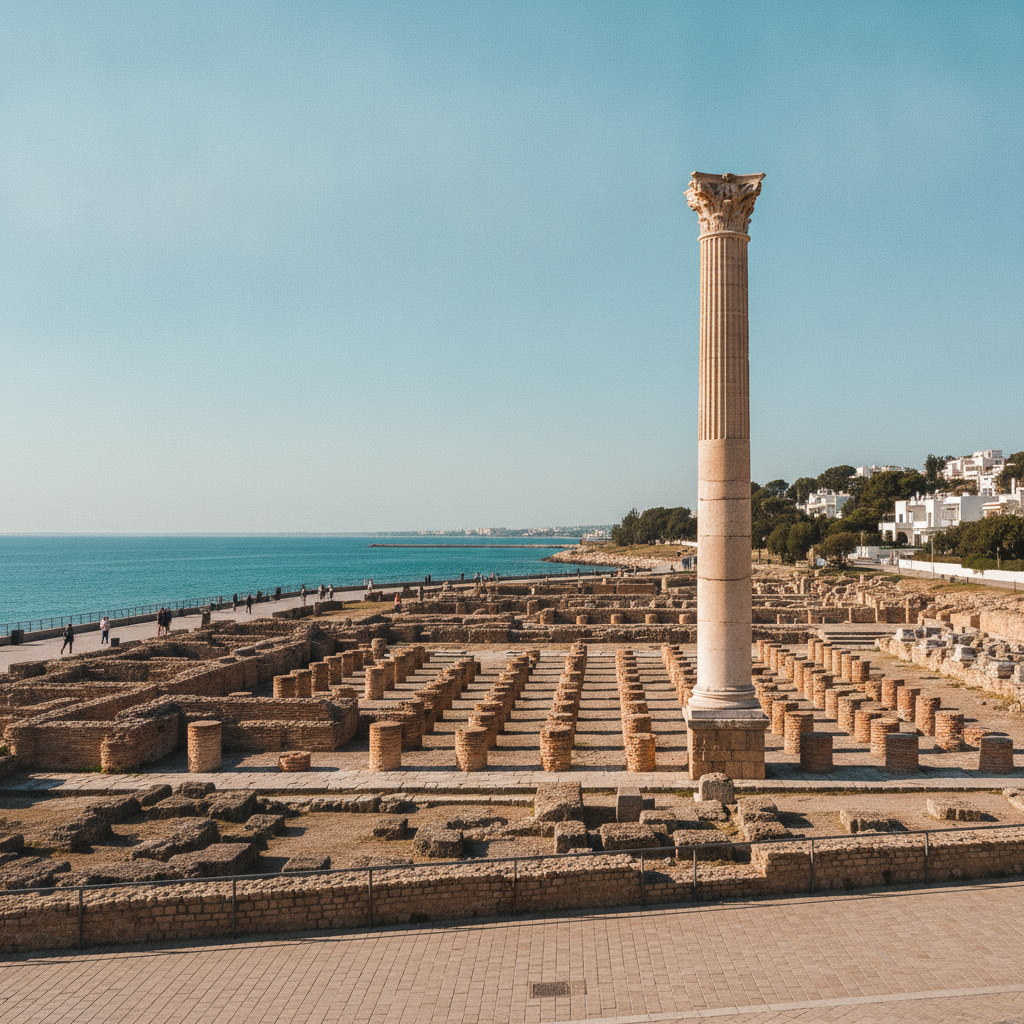
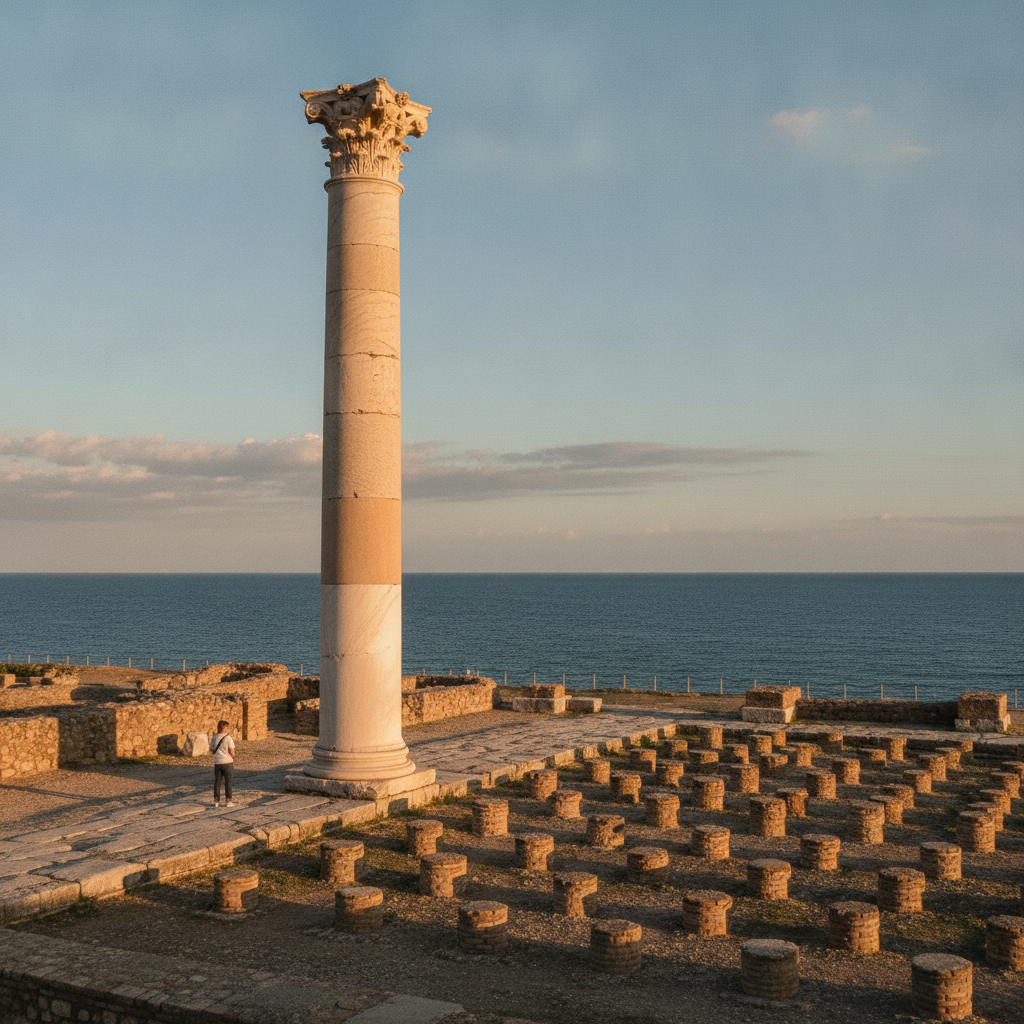
Dido Cut an Ox-Hide Into the Thinnest Possible Strips to Encircle Carthage's Founding Hill (Byrsa) and the Tophet Contains the Most Controversial Archaeological Debate in Mediterranean History; The Antonine Baths Were the Third Largest Roman Baths in the Empire and Their Single Re-Erected Column Represents a Frigidarium Once 52m x 42m; Perpetua's Prison Diary (203 CE) Written Before Her Execution in the Carthage Amphitheatre Is the Earliest Known Text Written by a Christian Woman
The Roman Senate Ordered the Mago Agricultural Treatise Translated Into Latin After Destroying Carthage Because It Was Too Valuable to Lose; Gaiseric's Vandals May Have Brought the Jerusalem Temple Menorah to Carthage in 455 CE Before Belisarius Captured It for Constantinople in 533 CE; Cato the Younger at Utica Re-Read Plato's Phaedo on the Immortality of the Soul Then Stabbed Himself Rather Than Submit to Julius Caesar
The Word Africa Derives From Afri the Berber-Punic People Near Carthage Making the Entire African Continent Named for a Carthaginian-Adjacent People; Purcell's Dido and Aeneas (1689) Aria When I Am Laid in Earth Is One of the Most Celebrated Baroque Arias; Tertullian of Carthage Coined Trinity, Person, and Sacrament and Cyprian's Extra Ecclesiam Nulla Salus (Outside the Church No Salvation) Shaped Catholic Theology for 1,600 Years