Battambang Arts & Circus Walk
Explore Battambang's arts scene — Battambang has become Cambodia's second cultural capital, with the Phare Ponleu Selpak circus school, a thriving street art scene, and the gallery and workshop culture that has developed around the city's artistic community.
- 1
Phare Ponleu Selpak Circus
Phare Ponleu Selpak (PPS, 'The Brightness of the Arts') in Battambang is the most remarkable arts education institution in Southeast Asia — founded in 1994 by returning Cambodian refugees and French NGO workers in a camp on the Thai border, the school now provides free arts education (circus, visual arts, music, and theatre) to vulnerable children and young people from the Battambang community. The PPS circus performance (held several evenings a week for the tourist audience) is the most spectacular arts performance accessible in Cambodia outside Phnom Penh — the students' acrobatics, the contemporary circus acts (combining traditional Khmer performance vocabulary with contemporary circus techniques), and the narrative sequences drawing on Cambodian mythology and history create the most emotionally powerful live performance available in Battambang.
- 2
Battambang Street Art
The street art murals covering the walls of Battambang's old quarter (the commissioned works by both Cambodian and international street artists that have transformed the shophouse walls of the commercial district into the most extensive outdoor gallery accessible in Cambodia) reflect the artistic community that has grown up in Battambang around the Phare Ponleu Selpak tradition — the murals' subjects (the traditional Cambodian life, the post-genocide rebuilding narrative, the contemporary Khmer cultural identity, and the international street art visual language) create a visual dialogue between the Cambodian past and the contemporary arts community's vision of the future. The concentration of murals in the riverside streets near the market area makes the street art walk the most rewarding pedestrian itinerary in the city centre.
- 3
Gallery Studios District
The gallery and studio spaces that have opened in the old shophouses of the Battambang commercial district (particularly the galleries representing Cambodian contemporary visual artists, the ceramics workshops maintaining the traditional Khmer pottery tradition, and the silk weaving operations producing the traditional Cambodian textile patterns) create the most complete arts district environment accessible in Cambodia outside the capital. The galleries' representation of Cambodian contemporary art (the paintings, sculptures, and mixed media works produced by the young Cambodian artists trained at the Phare Ponleu Selpak school and the Royal University of Fine Arts in Phnom Penh) is the most accessible single-city survey of contemporary Cambodian visual art available to the tourist.
- 4
Traditional Dance School
The traditional Khmer classical dance training visible at the Battambang arts schools and temple compounds (the court dance tradition almost destroyed by the Khmer Rouge's systematic murder of traditional artists and the cultural purge of the 1975-1979 period) documents the recovery of Cambodia's most distinctive artistic heritage — the classical Apsara dance (the stylised hand movements, the elaborate costume, and the narrative content drawn from the Hindu epics adapted into the Khmer cultural tradition) was preserved only because some of the trained dancers survived the genocide and were able to transmit the tradition to the next generation in the refugee camps and the post-liberation reconstruction period. The training classes visible in the Battambang arts schools are the most directly observable documentation of this cultural recovery process.
- 5
Ceramics Village Kampong Preah
The ceramics village of Kampong Preah (O Sra Lav) south of Battambang is the most significant surviving traditional pottery community in northwestern Cambodia — the village potters maintain the wheel-throwing and hand-building techniques for producing the traditional Khmer water storage jars, cooking pots, and the ritual ceramics used in Buddhist temple ceremonies. The pottery tradition's continuity in Kampong Preah (the village has maintained its pottery production through the French colonial period, the independence era, the Khmer Rouge period, and the contemporary tourism market) is the most direct available evidence of the deep roots of the ceramic craft in the Battambang cultural landscape.
- 6
Sunset River Arts Walk
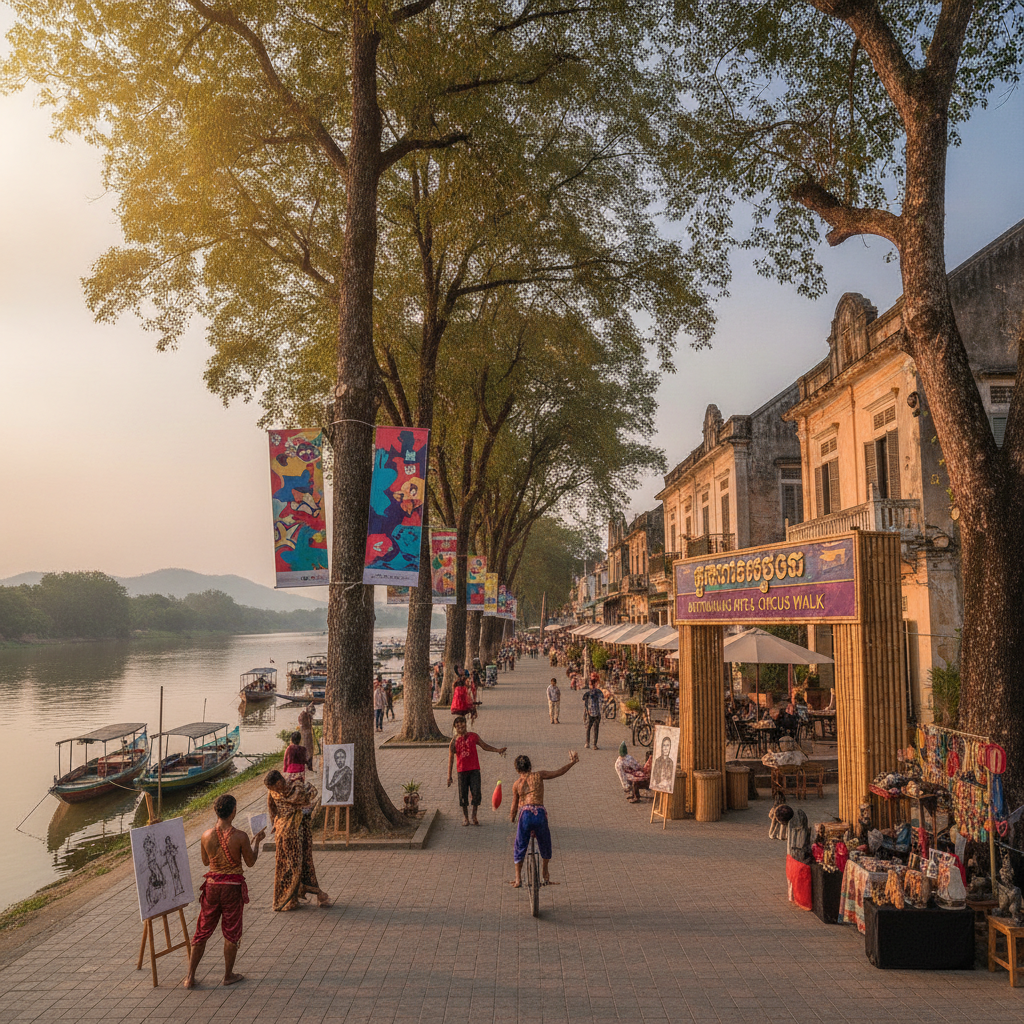
The riverside walk at sunset (along the Sangker River from the colonial boulevard to the arts district) provides the most atmospheric pedestrian itinerary in Battambang at the most photogenic time of day — the golden light on the colonial facades, the fishermen returning to the river bank with their catch, and the street food vendors setting up for the evening market create the visual vocabulary of the Battambang evening that is the most common subject of the photographs taken by the arts community resident in the city. The riverside arts café culture (the cafes and restaurants that have opened in the colonial shophouses facing the river, often with exhibition space displaying the work of the local arts community) provides the most appropriate setting for the end of the Battambang arts walk.
Walk this route with audio
Stories play automatically as you reach each stop — no tapping needed.