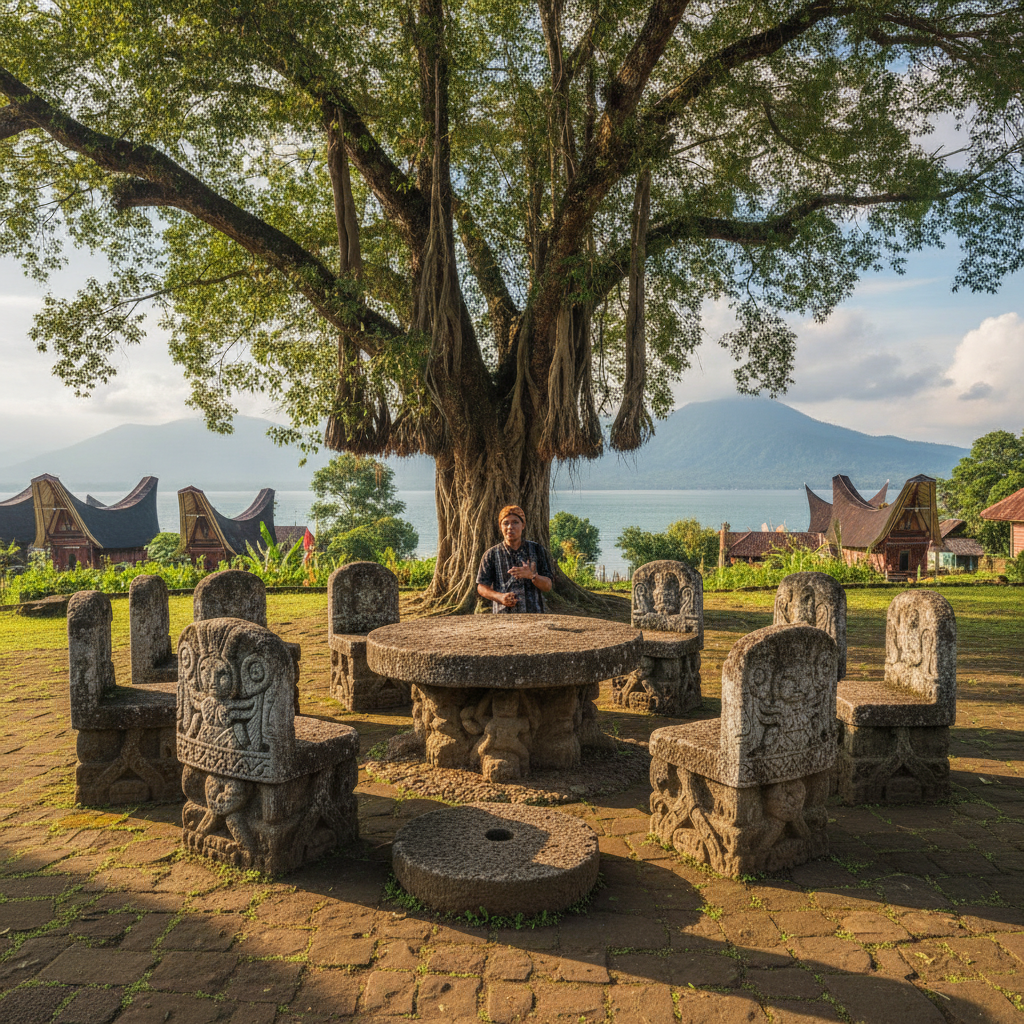
Lake Toba Batak Crafts & Cultural Heritage Walk
Explore Batak material culture through its handicrafts — the woodcarving, ulos textile weaving, goldsmithing, and other craft traditions of the Toba Batak represent a material culture archive that documents the cosmology, social values, and aesthetic sensibility of a highland people who developed sophisticated artistic traditions in relative isolation from the coastal cultures of Sumatra.
- 1
Batak Wood Carving Workshop
Batak wood carving is one of the richest carving traditions in Sumatra — the carved house facades, the gorga decorative panels, the tunggal panaluan ceremonial staff, and the utilitarian objects (spice containers, medicine boxes, musical instruments) all carry the distinctive Batak visual language of the singa face, the geometric interlace patterns, and the lizard (boraspati) motif that together constitute a decorative vocabulary encoding cosmological meaning. The carvers working in Samosir villages continue a tradition that was primarily religious in function before missionary contact but has been reoriented toward tourist craft production without losing the visual language.
- 2
Ulos Museum and Weaving
The ulos textile is the most culturally important material object in Batak society — the handwoven cotton or silk textile given at ceremonies from birth to death, with different ulos types appropriate for different occasions and social relationships, represents a textile language that encodes social information in its patterns, colours, and weave structure. The ulos weavers working on back-strap looms in Samosir village workshops maintain the technical tradition, and the market for ceremonial ulos (demanded at every Batak adat ceremony) ensures the economic viability of weaving as a primary occupation for Batak women.
- 3
Batak Gold Ornaments
Batak goldsmithing produced the ceremonial jewellery that marked high social status in traditional society — the elaborate gold necklaces (padung-padung), ear ornaments, and ceremonial accessories worn at weddings and funerals by high-status participants represent a metalworking tradition using locally mined gold that was transformed by its encounter with colonial trade goods and missionary discouragement of traditional religious practice. Contemporary Batak gold jewellery maintains traditional designs while serving the ceremonial market that continues to demand gold ornaments for major life cycle events.
- 4
Gorga Carved House Panel
The gorga decorative panels carved on traditional Batak house facades are among the most complex decorative systems in Indonesian art — the carved and painted wooden panels covering the facade of the rumah bolon with their interlocking geometric patterns, animal motifs, and the central singa face carry specific meaning related to the protective function of the house and the social status of the household. The traditional red (lilit), black (sinapotar), and white (siduri) colour scheme applied to the carvings has cosmological significance, with each colour associated with different spiritual domains in Batak cosmology.
- 5
Batak Performing Arts
The performing arts of the Toba Batak — the gondang music, the tortor dance, and the sigale-gale puppet dance — constitute an integrated ceremonial performance complex in which music, dance, and puppet theatre serve specific spiritual and social functions. The tortor dance, in which participants move their arms and hands in stylised gestures while moving sedately through a ceremonial space, is performed as an act of respect toward ancestors and supernatural beings, and the gondang music that accompanies it is believed to establish communication with the spirit world rather than serving purely aesthetic function.
- 6
Batak Crafts Market Samosir
The craft market at Tuk Tuk on Samosir Island offers the most comprehensive selection of Batak material culture available for purchase — the ulos textiles in different grades from tourist souvenirs to ceremonial quality, the carved wooden objects from mass-produced tourist items to genuine craft pieces, the traditional musical instruments, and the reproduction magical implements provide the visitor with both commercial craft culture and an opportunity to understand the original cultural context of the objects through conversation with the vendors who are themselves part of the Batak community maintaining these traditions.
Walk this route with audio
Stories play automatically as you reach each stop — no tapping needed.